


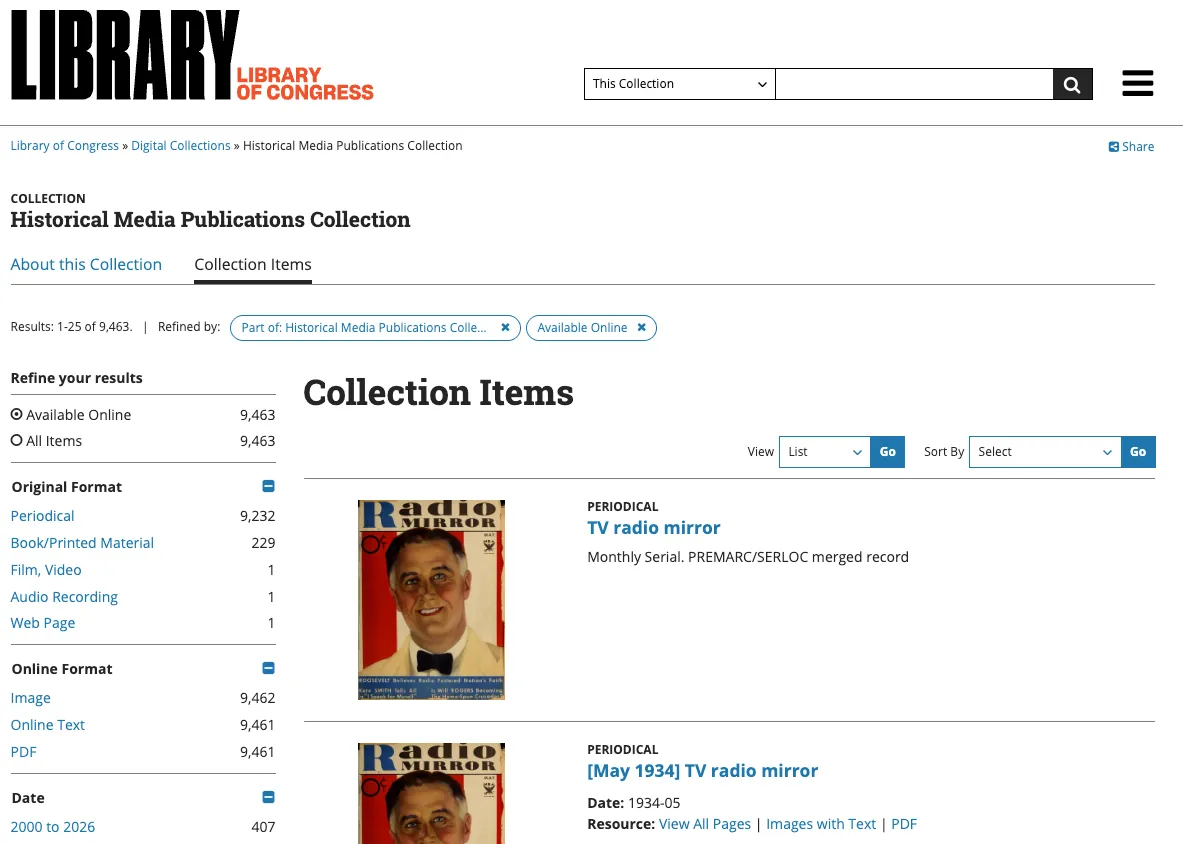
It’s not often that a single digital archive reshapes how we study the history of film, broadcasting, and American popular culture. But that is exactly what happened when the Library of Congress film magazines—a vast body of early 20th-century media publications—became widely accessible online through the Library’s Historical Media Publications Collection.
For decades, researchers relied on incomplete microfilm, scattered institutional files, or privately held volumes. Today, thanks to extensive digitization and collaboration efforts, the materials are accessible through the Library of Congress interface, offering unprecedented clarity and depth. This article walks through what the collection contains, why it matters, and how to use it for historically grounded research.
What Exactly Is the Historical Media Publications Collection of Library of Congress Film Magazines?
A Digital Archive Rooted in Early Film and Broadcasting History
The Library’s official database—the Historical Media Publications Collection—brings together publications documenting the emergence of film, radio, and television from the early to mid-20th century.
According to the Library of Congress, the collection includes:
- industry trade papers,
- fan magazines,
- monographs on film censorship,
- theater management guides,
- early broadcasting commentaries.
These publications complement the Library’s holdings at the National Audio-Visual Conservation Center (NAVCC), providing essential context for its film reels, radio broadcasts, and sound recordings.
Why This Matters to Researchers Today
The collection’s value lies in the primary-source detail it offers. These magazines serve as structured historical datasets disguised as popular media. Film historians, journalists, cultural researchers, and OSINT professionals use them to analyze:
- the formation of early celebrity culture,
- studio system marketing strategies,
- censorship debates,
- exhibitor economics,
- the rise of broadcasting as a national industry.
For example, 1920s issues of The Film Daily reveal early disputes over block-booking practices, while Photoplay exposes how studios shaped the narrative around scandals and star image management. Theater management manuals document enforcement approaches to local censorship laws—crucial for policy historians studying early media regulation.
The Origins of the Project — and Why Access Was Difficult Before
The Media History Digital Library and the 2011 Digitization Gap
The digitization push began with the Media History Digital Library (MHDL) in 2011. Until their intervention, most of these materials existed only as:
- low-resolution microfilm,
- partially missing runs,
- restricted-access institutional holdings.
The MHDL initiative recognized that scholars were interpreting early film publications without reliable visual or textual fidelity.
The Role of the Internet Archive and Lantern
Digitization was executed by the Internet Archive, producing volume-level scans. These were indexed and made searchable through UW–Madison’s Lantern platform, which quickly became a standard tool in academic film research.
The Library of Congress expanded the project by offering issue-level access, vastly improving the granularity of search and navigation.
What You Can Access in the Library of Congress Film Magazines Collection
Magazine Titles That Shaped the Early Film Industry
The collection includes historically influential titles such as:
- Photoplay – foundational to early celebrity journalism.
- Motion Picture Magazine – one of the earliest mass-audience fan magazines.
- The Film Daily – indispensable for reports on production schedules, finances, and studio negotiations.
- Motion Picture Herald – revealing exhibitor strategies, industry economics, and distribution issues.
These materials provide a multi-layered view of American film culture, from economic structures to narrative framing.
Search Filters and Digital Tools: How the Library of Congress Film Magazines Database Works
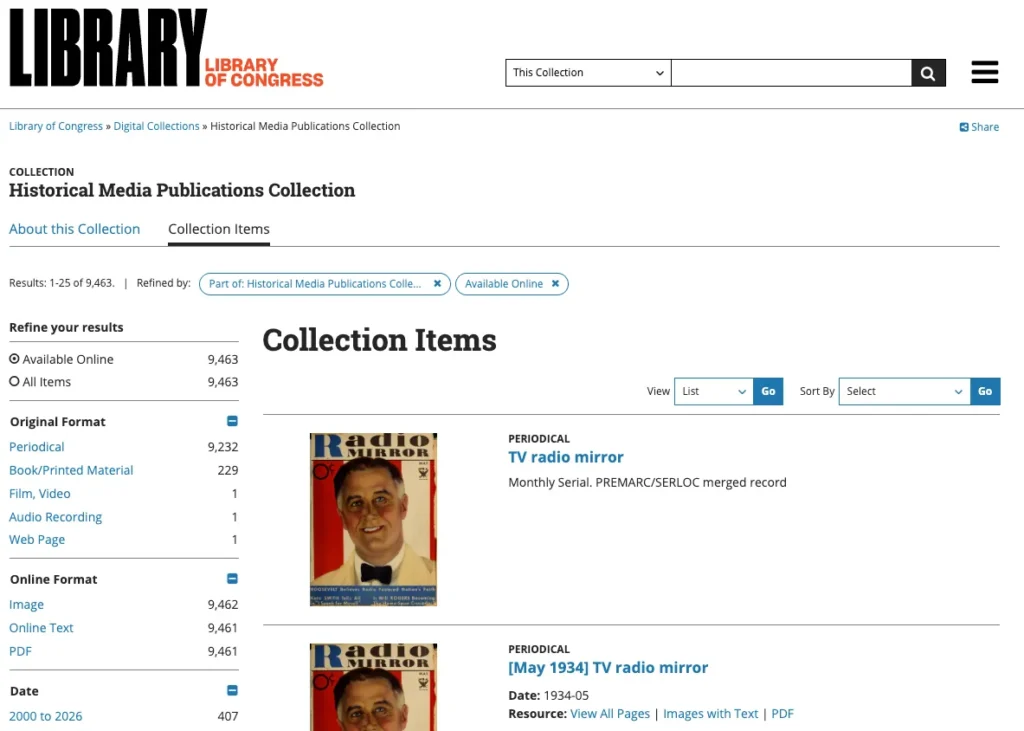
The Library’s interface allows filtering across multiple media types, including:
- magazines,
- photographs,
- films and videos,
- audio recordings,
- 3D objects.
Users can refine their search by:
- year range,
- subject tags,
- location,
- media format,
- availability (“online available” filtering).
Each magazine entry includes thumbnails, metadata, zoom tools, and navigable page structures—significantly improving usability compared to microfilm or PDF scans.
Example Searches That Reveal Hidden Film History
Real-world research scenarios demonstrate the depth of the collection:
- Silent-era censorship disputes
Searching “censorship” in 1920s trade papers uncovers state-by-state controversies over morality codes. - Broadcasting industry developments
1930s issues of Motion Picture Herald detail how early radio networks shaped advertising and public engagement. - Studio-driven fan narratives
Photoplay profiles and reader letters reveal coordinated PR strategies—useful for scholars examining propaganda, persuasion, and audience psychology.
These are not theoretical examples; they reflect how researchers actively use the archive today.
Strengths and Limitations of the Library of Congress Film Magazines Collection
Why This Database Is a Breakthrough
Key advantages include:
- Issue-level precision unmatched by other archives.
- High-resolution scans for accurate textual and visual analysis.
- Integration with broader Library of Congress audiovisual holdings.
This combination positions the collection as a uniquely valuable resource for historical and investigative research.
A Necessary Caveat: Historical Publications Reflect Their Era
The Library explicitly warns that these documents “reflect the attitudes, perspectives, and beliefs of different times” and may contain offensive or outdated content.
This is essential context: early publications often reinforced racial stereotypes, gender norms, and studio-controlled narratives. Researchers must approach them critically, understanding the cultural biases embedded in the material.
A similar warning appears in coverage by FilmBuffOnline, which emphasizes the need for historically informed interpretation.
Practical Tips for Using the Library of Congress Film Magazines in Research
How Journalists Can Leverage the Archive
Journalists use the collection to:
- verify early box-office narratives,
- reconstruct production timelines,
- examine studio–exhibitor disputes,
- investigate lost films or abandoned projects.
The ability to drill into specific issues allows for detailed fact-checking and nuanced reporting.
Academic and OSINT Use Cases
Researchers benefit in different ways:
- Film historians: trace shifts in production norms and studio governance.
- Cultural analysts: examine portrayals of gender, race, and morality across decades.
- OSINT specialists: map historical ownership of film companies, theaters, or broadcast stations using mentions in trade papers.
These magazines often contain corporate references missing from modern business registries, making them invaluable for long-term lineage analysis.
Downloading and Citing Materials
Entries typically include downloadable page images or PDFs.
For citation, scholars generally use Chicago or APA style, e.g.:
Photoplay, January 1923, Library of Congress, Historical Media Publications Collection.
Rights vary by publication, so users should verify permissions when reproducing images or excerpts.
How the Library of Congress Film Magazines Collection Fits Into the Broader Landscape of Film Data and Media Archives
Comparison to Other Film and Media Databases
- MHDL → excellent but primarily volume-level scans.
- Internet Archive → comprehensive but not optimized for issue navigation.
- BFI National Archive → strong UK perspective but limited U.S. trade press.
- UCLA Film & Television Archive → audiovisual focus rather than magazines.
The Library of Congress stands out by offering high-fidelity scans + issue-level access + metadata-rich search tools in one place.
What the Future of Digital Film Archiving Likely Holds
Anticipated developments include:
- improved OCR for damaged pages and handwritten notes,
- multimodal search (text + image),
- linked-data integration connecting magazines to film reels and production logs,
- expanded partnerships with digital humanities labs.
These innovations will continue to expand the analytical potential of film archives.
Conclusion: Why the Library of Congress Film Magazines Collection Matters
The Library of Congress film magazines collection is not simply a preservation project—it is a reopening of cultural, industrial, and artistic history. These publications shaped public understanding of film, celebrity, morality, and media power for decades. Now, researchers can examine these narratives with clarity and precision that earlier generations could not access.
For historians, journalists, students, and OSINT investigators, this archive is more than useful—it is foundational.
Researchers exploring archived film publications often rely on broader datasets to contextualize industry trends, which is why our Industry Databases section provides valuable tools for deeper investigation.
Sources
- Library of Congress – Historical Media Publications Collection
- Media History Digital Library – Project Overview
- Lantern Search Platform – lantern.mediahist.org
- FilmBuffOnline – Library of Congress Makes Collection of Classic Film Magazines Available Online
This article was created with AI assistance and reviewed by a human editor.

