


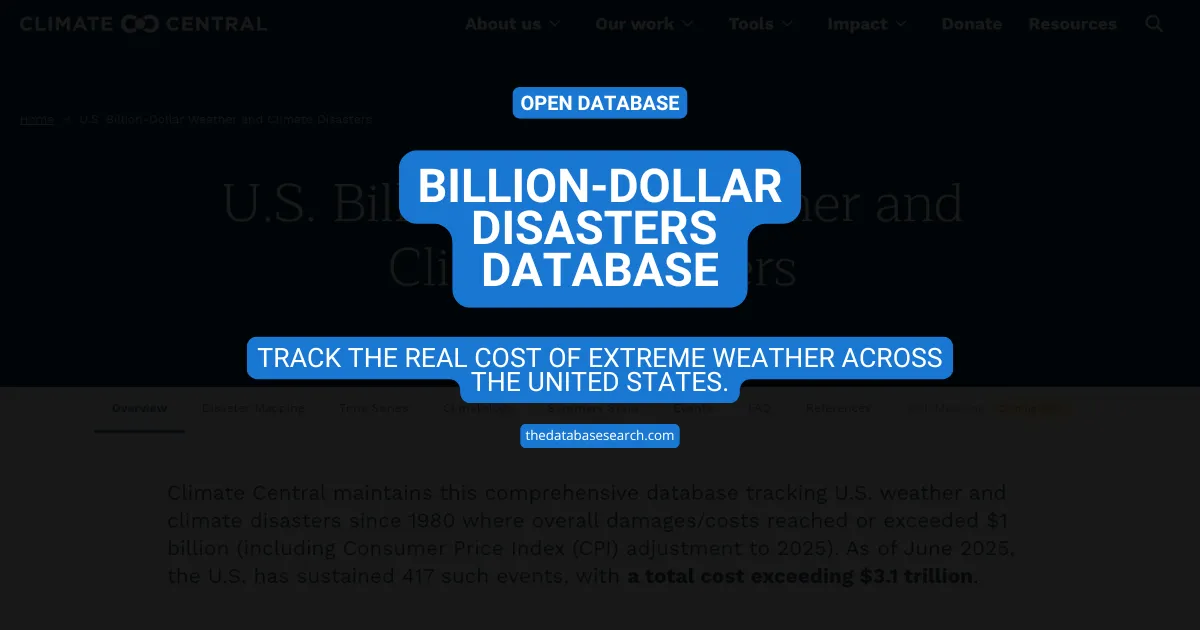
Extreme weather in the United States has crossed a threshold that earlier generations simply never experienced. Since 1980, the country has endured more than 417 billion-dollar disasters, generating over $3.1 trillion in total losses when adjusted for inflation. These numbers come from Climate Central’s Billion-Dollar Disasters Database—one of the most comprehensive and public-facing climate risk datasets available today.
You are not looking at a typical climate graph. It is an account that reveals step by step how natural disasters like hurricanes, wildfires, severe storms, droughts, and floods are altering the U.S. economy on a yearly basis. The chart has already been adopted by journalists, researchers, insurers, and policymakers, as well as offered to local communities who need to identify the effects of climate-induced hazards on living and non-living areas.
The next part consists of an in-depth, critical, and practical guide to the dataset: the contents, operation, revelation, and responsible interpretation.
What Is the Billion-Dollar Disasters Database?
Climate Central is taking care of this dataset which is meant to keep track of every U.S. weather and climate disaster since the year 1980 that has led to at least $1 billion in total direct losses. These losses include not only the infrastructure that has been ruined but also the agricultural impacts, costs for putting out fires, and so on.
The dataset relies heavily on NOAA’s initial approach and data in historical context. In case readers want to learn about NOAA’s larger climate archives, they can consult our detailed guide to NOAA Climate Data Online.
From NOAA to Climate Central
For more than 40 years, the dataset was managed by NOAA’s National Centers for Environmental Information (NCEI). In 2025, Climate Central assumed stewardship and rebuilt the interface into a modern, interactive platform designed for public accessibility, data storytelling, and state-level risk interpretation. Climate Central continues to apply the methodological standards validated in NOAA’s widely cited paper “U.S. Billion-Dollar Weather and Climate Disasters: Data Sources, Trends, Accuracy and Biases” (Smith & Katz, 2013).
The transition reflects a broader shift: climate data is no longer “for specialists only.” Communities, journalists, and city planners increasingly rely on open-access datasets to understand exposure and risk.
What the Billion-Dollar Disasters Database Reveals About What Counts as a Billion-Dollar Disaster
An event enters the database if total direct economic losses exceed $1 billion, adjusted to 2025 dollars (using the Consumer Price Index).
Included impacts:
- Structural damage (residential, commercial, municipal buildings)
- Roads, bridges, levees, and electrical infrastructure
- Agricultural losses (crops, livestock, timber)
- Vehicles, boats, equipment
- Offshore energy platforms
- Business interruption caused by physical damage
- Wildfire suppression efforts
What’s not included—despite measurable societal cost:
- Environmental degradation
- Loss of natural capital
- Health-related costs
- Mental health burden
- Long-term displacement
- Supply chain and indirect business interruption
- Statistical value of life (VSL)
As Climate Central notes, these omissions produce conservative estimates. NOAA’s original methodological review found that overall losses may be underestimated by 10–15%.
Why the Billion-Dollar Disasters Database Matters: Trends That Can’t Be Ignored
The Cost of Disasters Is Accelerating
A 45-year view shows a clear pattern: more events, rising costs, and increasing regional clustering. According to Climate Central, the 2010–2019 decade was the most expensive on record—even after adjusting for inflation.
This escalation is driven by three intertwined forces:
1. Increased Exposure
More homes, businesses, and infrastructure have been built in harm’s way—coastal zones, river floodplains, and the expanding wildland–urban interface.
2. Increased Vulnerability
Aging infrastructure and inconsistent building codes amplify damage. Even storms that were once moderate now cause outsized losses.
3. Changes in Hazard Frequency and Intensity
Findings from the Fifth National Climate Assessment (2023) show:
- heavier rainfall events in the Eastern U.S.,
- longer wildfire seasons in the West,
- increased coastal flood risk driven by sea-level rise,
- more frequent billion-dollar droughts.
When these structural and climatic factors align, the financial consequences compound.
A Real-World Example: Wisconsin’s Growing Storm Bills
In October 2025, Wisconsin Watch published a detailed investigation into how extreme weather is eroding economic stability across the Mississippi River Basin. Their article, “Wisconsin billion-dollar disaster storm damage tracking tool”, used Climate Central’s database to show how storm clusters—particularly severe convective storms—have repeatedly produced billion-dollar losses across Wisconsin counties.
This is the power of the dataset: it doesn’t just list events—it exposes patterns. Wisconsin’s case illustrates what many states now face: a cycle of recurring billion-dollar storms rather than rare, isolated catastrophes.
Inside the Billion-Dollar Disasters Database: The Tools That Make It Useful
Climate Central provides multiple analytical tools within the Billion-Dollar Disasters platform. Each serves a different purpose.

1. Disaster Mapping
The interactive mapping tool visualizes all billion-dollar events spatially. Users can filter by:
- hazard type
- year range
- damage metrics
- single-event mapping
To illustrate, the tracking of floods in the Midwest from 2008–2020 shows a distinct path of recurring riverine calamities—this is a piece of information which is very important for the local authorities in deciding on the levee enhancement or the floodplain zoning rearrangement.
2. Time Series Analysis
The Time Series tool displays year-to-year frequency and cost trends. It highlights inflection points such as:
- the cost explosion after 2005 (Hurricanes Katrina, Rita, Wilma),
- the surge in severe storm costs during the 2010s,
- the record-setting disaster counts in 2023 and 2024.
These visuals are widely used in congressional testimony, insurance risk modelling, and ESG reporting.
3. Climatology Charts
The Climatology section shows a monthly breakdown of billion-dollar disasters over 46 years. Seasonal patterns emerge:
- Hurricanes peak August–October
- Wildfires peak July–September
- Severe convective storms peak March–June
This context helps reporters explain seasonal risks more accurately.
4. Summary Statistics Dashboard
One of the most interactive features, the Summary Stats tool allows filtering by state, region, hazard type, and time period. Users can:
- compare disaster histories between states
- identify which hazards dominate in a particular region
- analyze how risk has shifted over decades
This is the same interface journalists used in the Wisconsin Watch report to quantify storm costs at the state level.
5. Event Catalog
Finally, the Events browser lists every disaster individually, with:
- cost estimates
- affected states
- duration
- hazard classification
- source references
It is the go-to tool for academic research or investigative reporting.
Methodology Behind the Billion-Dollar Disasters Database: How Climate Central Calculates Costs
Climate Central aggregates over a dozen public and private data sources, including:
- FEMA Public Assistance and Individual Assistance
- USDA crop indemnity programs
- National Flood Insurance Program claims
- National Interagency Fire Center wildfire records
- State emergency management offices
- Private insurance industry reports (AON, Munich Re, Gallagher Re)
- NOAA Storm Events Database
- U.S. Army Corps of Engineers infrastructure damage
The methodology is documented in peer-reviewed and government literature, and continues to evolve. Climate Central is currently developing a sub-billion dataset to track all events exceeding $100 million in losses—scheduled for release in 2026. This will significantly broaden the hazard risk picture.
How Journalists, Researchers, and Policymakers Use the Dataset
- Local governments use it for hazard mitigation planning.
- Insurance analysts incorporate it into risk pricing and regional exposure models.
- Journalists use it to contextualize extreme weather stories, as seen in the Wisconsin Watch investigation.
- ESG analysts use the data to assess climate-related financial risk—see our ESG Databases collection for related datasets.
- Researchers integrate it with socioeconomic indicators to study inequity in climate vulnerability.
It has become a foundational dataset for understanding climate risk across the United States.
How to Use the Billion-Dollar Disasters Database Responsibly
Climate cost data is powerful—but easy to misinterpret. Before citing or mapping an event:
- Check what’s included and excluded (remember: no VSL, no environmental loss).
- Consider exposure changes—more development increases losses even without hazard intensification.
- Pair with other datasets, especially FEMA, Census ACS, and NOAA rainfall/sea-level data.
- Avoid simplistic causation claims—hazards, exposure, and vulnerability all shape outcomes.
Conclusion
The Billion-Dollar Disasters Database is not just a catalog of extreme events; it is a long-term socioeconomic record of the changing landscape of American risk. The occurring billion-dollar disasters have shifted the national economy since 1980.
Getting to know these facts—where it all comes from, who all are watching it, and how quickly it is happening—has become vital for the journalists, policymakers, researchers, and every community that is getting ready to face a more unpredictable climate.
Further Reading & Related Resources
- Climate Central – Billion-Dollar Disasters Database
https://www.climatecentral.org/climate-services/billion-dollar-disasters - NOAA Climate Data Online (TheDatabaseSearch Guide)
https://thedatabasesearch.com/esg-databases/noaa-climate-data-online/ - ESG Databases – TheDatabaseSearch.com Category
https://thedatabasesearch.com/category/esg-databases/ - Wisconsin Watch – Storm Damage Tracking Tool Report
https://wisconsinwatch.org/2025/10/wisconsin-billion-dollar-disaster-storm-damage-tracking-tool-trump-mississippi-river-basin/
This article was created with AI assistance and reviewed by a human editor.

