


The question of transparency has drastically changed the contemporary US healthcare system. The Open Payments Database plays a central role in this shift. The patients’ demand for the disclosure of the doctors’ financial relationships with the firms that make the drugs, devices, and biologics that they are prescribing has become a right. Journalists and researchers need reliable, federal-level data to conduct their investigation about possible conflicts of interest, and they are looking for that data. At the same time, compliance officers are demanding accurate and traceable records to meet the requirements of the law.
The Open Payments database managed by the Centers for Medicare & Medicaid Services (CMS) is regarded as the principal method used by the federal government to monitor the financial relationships in the healthcare industry. This manual will assist you in comprehending the operation of the Open Payments database, the useful insights that can be gained from the data, and who knows, maybe even bringing it out to your benefit, if you are a patient, a policy researcher, or an investigative reporter.
What Is the Open Payments Database?
The Open Payments program was originally set up by the Physician Payments Sunshine Act, which is incorporated in the Affordable Care Act. The intention of the program is very simple: to reveal the money exchanged between the industry and the professionals and to make it public knowledge in case of teaching hospitals.
At its core, the database tracks:
- Payments from pharmaceutical companies
- Payments from medical device manufacturers
- Transfers of value to physicians and teaching hospitals
- Financial relationships such as consulting fees, travel, meals, royalties, and research funding
- Ownership or investment interests held by physicians in industry companies
The database is U.S. federal, updated annually, and operated by CMS—the same agency that runs Medicare, Medicaid, and other major national healthcare programs.
Transparency is the primary goal. The data does not determine whether a payment is inappropriate; it simply documents the relationship.
Who Is Included in the Open Payments Database?
Open Payments covers three main groups:
Physicians
CMS tracks payments to:
- Medical doctors (MD)
- Doctors of osteopathic medicine (DO)
- Dentists, podiatrists, and optometrists in certain cases
- Chiropractors and other specialties when they fall under federal rules
Physician assistants and nurse practitioners were added more recently, expanding the database’s reach.
Teaching Hospitals
Any hospital that gets Medicare’s graduate medical education payments is viewed as a teaching hospital. These organizations are important because they run clinical trials, get huge research grants, and are frequently in partnership with medical device companies.
Applicable Manufacturers
These include:
- Pharmaceutical companies
- Biologic manufacturers
- Medical device companies
- Entities involved in drug or device marketing
Payments must be reported even if they are as minor as a meal at a conference or as large as a multi-year consulting arrangement.
Types of Payments Reported
Payments are categorized into three core groups:
1. General Payments
These include:
- Consulting fees
- Travel and lodging
- Meals
- Speaking engagements
- Education payments
For example, a neurologist who participates in a device advisory board might receive a $600 consulting fee—this would appear as a general payment.
2. Research Payments
These cover:
- Clinical trial funding
- Study-related support
- Research grants
Payments may go directly to a physician or through a medical institution.
3. Ownership or Investment Interests
Physicians who own equity in a company—stock, partnership stakes, or other investments—are included here. This is one of the most scrutinized areas because it can create complex or opaque financial incentives.
How to Use the Open Payments Database Search Tool (Step-by-Step)
CMS designed Open Payments for both casual use (simple name search) and advanced analysis (full dataset downloads). Below is a practical walkthrough.
Step 1 — Access the Open Payments Database
Go to the Open Payments Search Tool, where the landing dashboard allows you to look up physicians, hospitals, companies, or products.
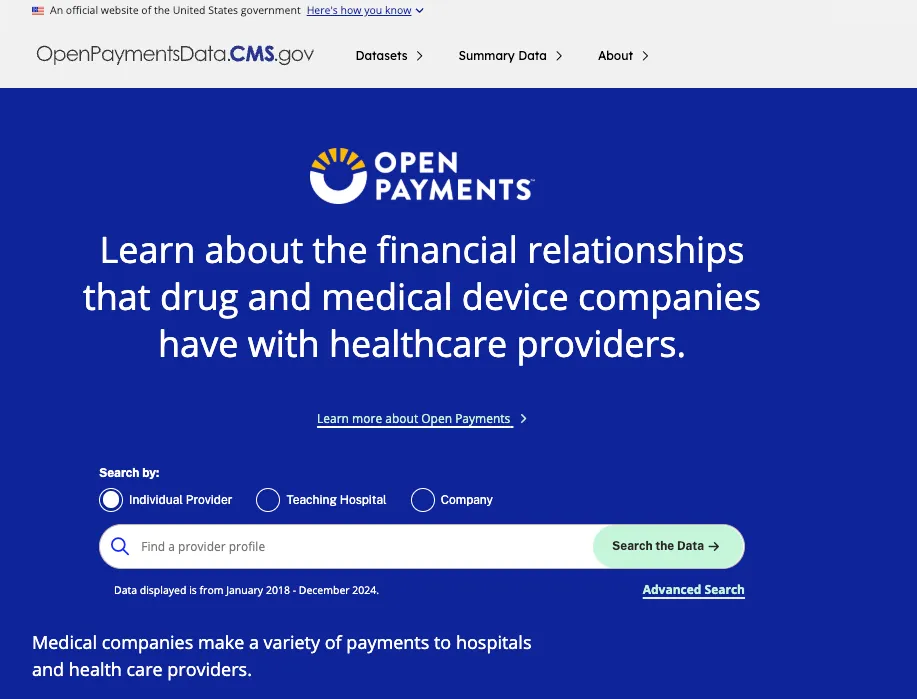
Step 2 — Search by Physician or Hospital
For patients and journalists, this is usually the most relevant entry point.
You can search by:
- Physician name
- City and state
- Specialty
- Teaching hospital name
Results show:
- Total amount received
- Payment types
- Number of transactions
Each physician has a profile page summarizing their financial relationships.
Step 3 — Search by Company or Product
If you want to investigate how a specific manufacturer distributes money—e.g., marketing a new diabetes drug—search by company name or product name.
Useful for:
- Market analysis
- Conflict-of-interest reporting
- Cross-industry comparisons
Step 4 — Explore Detailed Open Payments Database Records
Opening a payment record reveals granular information:
- Amount
- Payment date
- Payment category
- Associated product
- Context (e.g., “food and beverage at conference dinner”)
Even small payments—like a $32 meal—must be reported.
Important note: small payments often accumulate into significant totals over hundreds of interactions.
Step 5 — Download Bulk Data (CSV / Full Dataset)
For deeper research, CMS allows full bulk downloads.
Includes:
- Flat files for each payment type
- A data dictionary
- Year-by-year structured datasets
The data is large, often requiring specialized software to analyze effectively.
Understanding the Open Payments Database Data—and Its Limits
The Open Payments database is robust, but like all large administrative datasets, it has boundaries you should understand before drawing conclusions.
1. Self-Reported Information
Manufacturers submit their own data, which CMS later audits. Errors can occur, though disputes are processed and corrected annually.
2. Missing Specialties
Certain healthcare professions are not included (e.g., some allied health professionals), and reporting requirements evolve over time.
3. Reporting Thresholds
Small facilities or rare payment types may not meet reporting minimums.
4. No Judgment on Appropriateness
The database does not label payments as ethical or unethical—it only provides transparency.
Practical Use Cases of the Open Payments Database
For Patients
- Evaluate whether your doctor has financial ties to companies whose products they recommend.
- Compare payment patterns across specialties or regions.
Journalists
- Investigate potential conflicts in clinical decision-making.
- Link payment patterns to prescribing behavior or research participation.
- Build data-driven accountability stories.
Researchers & Policy Analysts
- Analyze sector-wide trends (e.g., cardiology vs. oncology payments).
- Examine the commercialization of medical technology.
- Compare research vs. marketing payments.
Compliance Officers
- Benchmark your organization against peers.
- Track industry relationships for internal reporting.
- Identify potential areas of regulatory risk.
Tips for Accurate Interpretation
- Always check whether payments are general or research.
- Avoid assuming causation based on correlation.
- Look at trends across multiple years rather than single data points.
- Verify unusually high payments by reviewing record details.
- Cross-check related datasets for context (Medicare, clinical trials, FDA safety data).
How Often Does CMS Update the Open Payments Database?
CMS updates the database annually, typically following this cycle:
- Spring: Manufacturers submit data
- Summer: Dispute and correction period
- Late summer / early fall: Publication of new data
- Ongoing: Historical corrections and auditing
Each annual dataset includes all payments from the previous calendar year.
Open Payments Database FAQ
Are All Doctors Included in the Open Payments Database?
Most physicians are included, but not all. Some specialties or practitioners may be outside the reporting scope.
Does receiving payments indicate wrongdoing?
Not necessarily. Many payments reflect research funding, education, product training, or collaborations.
How reliable is the data?
It is self-reported but audited by CMS. Disputes and corrections are part of the annual update cycle.
Can I Download the Full Open Payments Database Dataset?
Yes. Bulk files are available for each year in CSV format.
Conclusion
The Open Payments Database is a major transparency tool in the U.S. healthcare system, and it is now used more widely than ever. It reveals the financial connections between physicians and the medical industry, and as a result it gives patients, researchers, journalists, and compliance officers clearer insight, better questions to ask, and more informed decision-making power.
When used properly—along with other data sets such as Medicare payment policies, FDA adverse event reports, and clinical trial registries—it gives a clearer picture of how much financial drivers influence the American healthcare system.
Related Database
- Clinical Trial Databases guide
- NPPES NPI Registry overview
- Health Databases collection
- Medicare Coverage Database guide
Sources
- Centers for Medicare & Medicaid Services (CMS) – Open Payments Program Overview
https://www.cms.gov/openpayments - Open Payments Data Portal (CMS) – Search Tool & Bulk Data
https://openpaymentsdata.cms.gov/ - Physician Payments Sunshine Act – Federal Register Final Rule (42 CFR Part 403)
https://www.federalregister.gov/documents/2013/02/08/2013-02572/medicare-medicaid-childrens-health-insurance-programs-transparency-reports-and-reporting-of-physician - Government Accountability Office (GAO) – CMS Oversight of Open Payments Data
https://www.gao.gov
This article was created with AI assistance and reviewed by a human editor.

