


The Climate Policy Database built by the OECD’s Inclusive Forum on Carbon Mitigation Approaches (IFCMA) does something most climate resources never attempt. Instead of estimating emissions or modeling future scenarios, it documents the actual policy instruments that governments have written into law. As a result, anyone can finally compare how nations tax carbon, ban combustion engines, or subsidize clean power, side by side, in one structured dataset. However, there is a detail that surprises most American readers immediately: the United States is not in it. That single absence says a great deal about both the value and the limits of this resource, and it is exactly where this analysis begins.
Why the Climate Policy Database Matters Right Now
Climate policy has always suffered from a transparency problem. Each country publishes its laws in its own language, its own legal format, and its own bureaucratic silo. Therefore, comparing Sweden’s carbon tax to Korea’s emissions trading system has historically required specialist knowledge, translation, and weeks of legal research. The IFCMA Climate Policy Database collapses that effort into a searchable framework.
The resource currently catalogs more than 5,400 policy instrument records across 41 jurisdictions, drawn from the April 2026 release. Moreover, every entry follows the same template. A feed-in tariff in France and a feed-in tariff in Japan therefore use identical variables. For researchers, journalists, and investors, that consistency is the entire point. In addition, the data is validated by the member countries themselves, a step that separates it from crowdsourced trackers that rely on volunteers or scraped legislation.
For context on how this fits the broader landscape of sustainability data, our overview of ESG databases shows where policy-tracking tools sit alongside disclosure and emissions resources. The Climate Policy Database occupies a specific niche: it tracks the rules, not the outcomes.
What the Climate Policy Database Actually Contains
Understanding the structure helps explain why this dataset is more useful than a simple list of climate laws. The IFCMA Climate Policy Database systematically classifies and describes policy instruments across member countries, and it captures far more than a policy name and a date.
Four Core Design Features
The database is built around four features that work together. First, a clear typology groups policy instruments into consistent categories based on how they operate. Second, a comprehensive framework describes each instrument across multiple dimensions using standardized variables. Third, the dataset records detailed information on policy design and implementation rather than headlines. Finally, members validate the data to increase accuracy. Consequently, the result is a reference tool rather than a news archive.
The Instrument Categories
Every policy is sorted into one of three broad approaches: economic, regulatory, or informational. Within those, the database tracks distinct instrument types. For example, the catalog includes:
- Subsidies — feed-in tariffs, carbon contracts for difference, vehicle purchase rebates, and low-emission fuel support (448 records).
- Taxes — GHG taxes, fuel excise taxes, road use charges, and clean corporate income tax incentives (more than 1,250 records).
- Trading schemes — emissions trading systems and tradable energy efficiency certificates.
- Performance standards — minimum energy performance rules for buildings, appliances, and vehicles (over 2,100 records).
- Technology standards — bans and phase-outs of combustion vehicles, fossil heating, and short-haul flights.
- Comparative energy efficiency labels — mandatory labeling for buildings, products, and vehicles.
Performance standards dominate the dataset, which tells its own story. In practice, governments regulate efficiency far more often than they price carbon directly. For instance, the database lists hundreds of Minimum Energy Performance Standards covering everything from water heaters to residential solar panels.
How to Search the Climate Policy Database
The OECD publishes the data through an interactive IFCMA climate policy dashboard, and it also offers the full dataset as a downloadable spreadsheet. Both routes serve different needs, so choosing the right one saves time.
The dashboard works best for browsing. It opens with an overview of the database’s scope, then lets you drill into country-level data to see which instruments a specific nation has adopted. Alternatively, the instruments view lets you start from a policy type and see which countries use it. That second path is the more powerful one for comparative research.
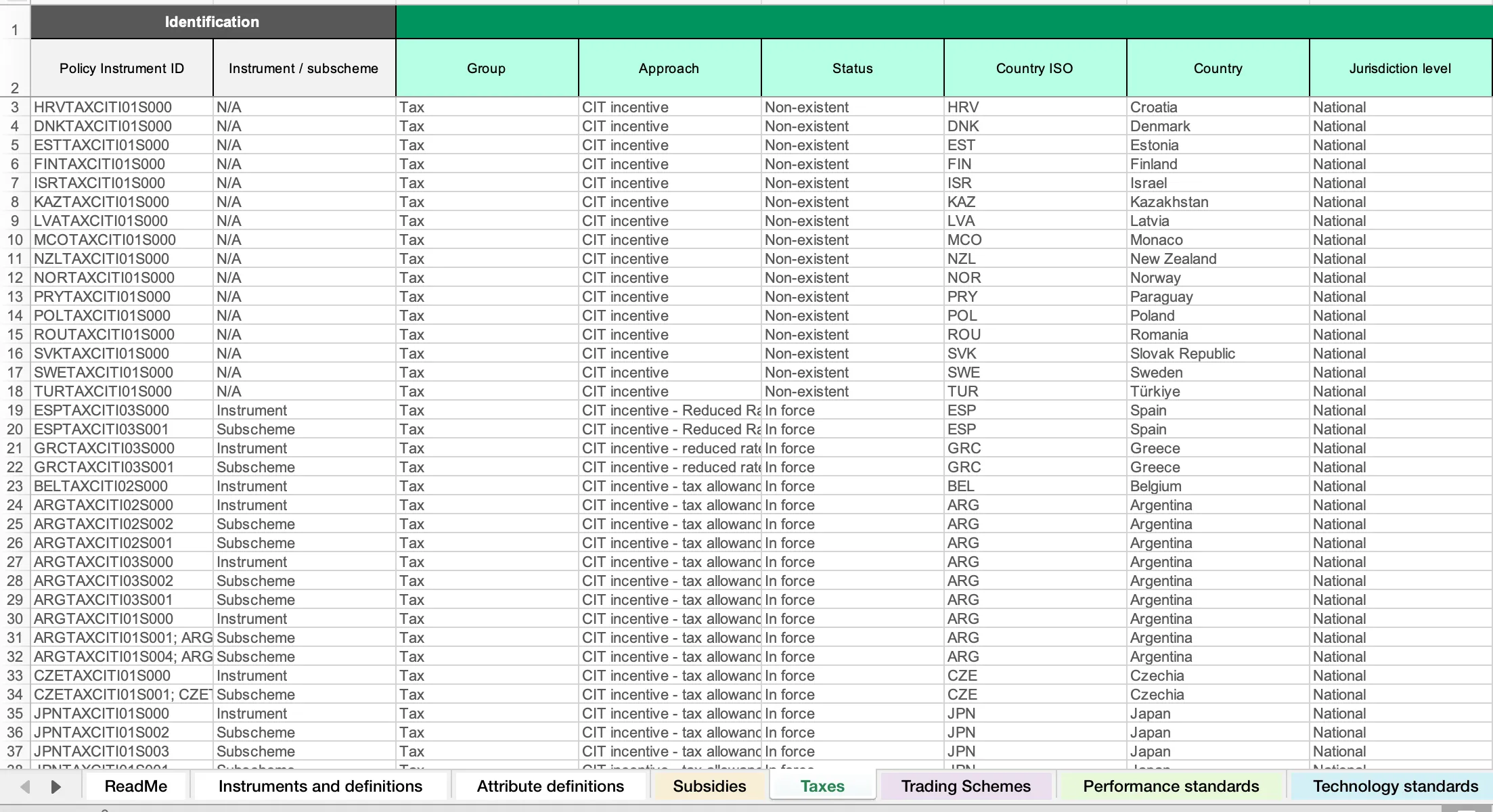
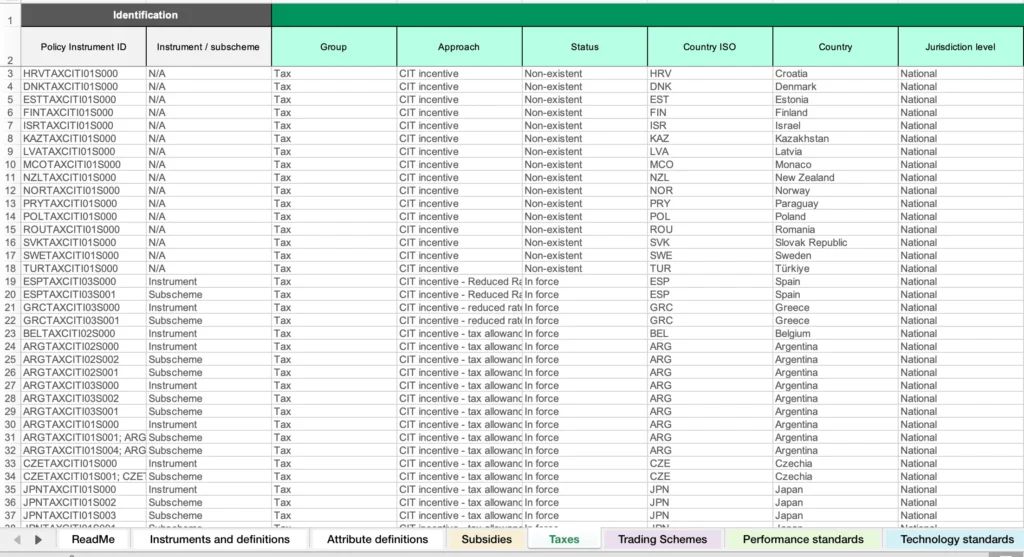
The downloadable spreadsheet, by contrast, rewards anyone doing serious analysis. Each row represents a single policy instrument or a subscheme, and roughly 60 columns describe its design. Therefore, a researcher can filter for, say, every emissions trading system and instantly compare caps, free allowances, and offset rules across jurisdictions. The accompanying concepts and documentation page explains every variable, which prevents misreading the codes.
Reading the Data Correctly
One feature trips up first-time users, so it deserves a clear warning. Blank cells mean missing data. However, a cell marked “Non-existent” means something very different: it confirms that researchers checked thoroughly and found no such policy in that country. Meanwhile, “N/A” signals that an attribute was irrelevant or that a country confirmed an instrument exists but did not validate every detail. Confusing these three states leads to wrong conclusions, so reading the documentation first is essential.
Who Uses the Climate Policy Database, and Why
The audience for the Climate Policy Database is narrower than a general news site, yet it is unusually influential. Climate economists use it to study which instruments actually get adopted, as opposed to which ones get debated. In addition, financial analysts assessing transition risk rely on it to understand the regulatory exposure of carbon-intensive assets across markets.
Investors form a particularly important user group. A fund holding European industrial stocks, for example, can use the database to map every carbon tax and trading scheme that touches its portfolio. For that kind of capital-flow analysis, this resource pairs naturally with our guide to the International Climate Finance Database, which tracks the money side of climate action rather than the legal side.
Journalists and policy advocates use it differently. Because the data is standardized, a reporter can credibly state that a given number of countries have adopted bans on combustion-engine vehicles without compiling that count by hand. The database records dozens of such phase-out instruments, which turns a vague claim into a verifiable one.
What Makes It Different From Other Climate Trackers
Several climate policy trackers already exist, so a fair question is what the IFCMA version adds. The distinction comes down to depth and validation. Many older trackers record whether a policy exists; this one records how the policy is engineered.
Consider an emissions trading system. A typical tracker notes that the country has an ETS. The IFCMA database, by contrast, records the deeper design choices. It shows whether the system uses a cap-and-trade or baseline-and-credit design, whether offsets are allowed, how allowances are distributed, and whether it links to other systems. As a result, the data supports genuine comparison rather than a simple yes-or-no map.
Government validation is the second differentiator. Crowdsourced databases drift out of date and occasionally contain errors that nobody corrects. Here, member countries review their own entries, which raises reliability. Of course, validation is not the same as perfection, and that brings us to the harder questions.
The Limitations You Need to Understand
No serious analysis should treat any database as a neutral mirror of reality, and this one carries real constraints. Acknowledging them is what separates careful research from naive citation.
The Coverage Gap
The most significant limitation for a North American audience is coverage. The April 2026 release spans 41 jurisdictions, heavily weighted toward Europe, with France, the Netherlands, Slovenia, Finland, and Italy holding the largest number of records. Notably, the United States and Canada are both absent. Therefore, an American reader cannot use this tool to look up domestic policy, and any “global” comparison drawn from it actually excludes the world’s largest economy. For U.S. climate data, resources like NOAA Climate Data Online and the Toxics Release Inventory remain the better starting points.
Completeness and Validation Gaps
Even within covered countries, the data is uneven. The OECD notes that some members confirmed that an instrument exists but did not validate every design detail. In those cases, most attribute fields show “N/A,” which means the record confirms existence without describing the policy fully. Consequently, a country that looks sparse in the database may simply have validated less of its data, not adopted fewer policies.
Scope Boundaries
The database focuses on national-level instruments and, in federal countries, selected subnational ones. As a result, municipal taxes, local building codes, and city-level programs generally fall outside its scope. For a country like the United States, where much climate policy happens at the state and city level, that boundary would have been a meaningful blind spot even if the country were included.
Transparency Value and Data-Quality Questions
Despite those limits, the transparency contribution is substantial. By forcing every policy into a shared vocabulary, the Climate Policy Database makes hidden design choices visible. For example, two countries can both claim to have a carbon tax, yet one might exempt entire industrial sectors while the other does not. The structured fields expose that difference, which raw legislation rarely does at a glance.
On data quality, the picture is honest rather than flawless. Country validation improves accuracy, but it also introduces a subtle bias: governments review how their own policies are described. Therefore, the framing tends to reflect each government’s stated objectives. Because every record links to the underlying legal statute and source documents, however, users can verify claims independently. That traceability is the single most important quality safeguard the database offers.
Privacy concerns, by contrast, are minimal here. The dataset describes laws and regulations, not individuals or companies, so it raises none of the personal-data issues that follow consumer or corporate databases. This is public-interest information by design.
Where the Climate Policy Database Fits
The IFCMA Climate Policy Database is best understood as a specialist instrument, not a universal answer. For comparing the legal architecture of climate policy across major economies, it is among the most rigorous public tools available. Yet its European tilt and the absence of the United States mean American users should treat it as a window into international practice rather than a domestic reference.
Used that way, it becomes genuinely valuable. An investor gauging transition risk in European markets, a researcher studying which carbon-pricing designs survive political reality, or a journalist verifying a global policy count will all find something here that no other free resource provides. The key, as always, is to read its documentation, respect its boundaries, and pair it with the right U.S.-focused sources when the question turns homeward.
Sources
- OECD — IFCMA Climate Policy Dashboard: https://www.oecd.org/en/data/dashboards/ifcma-climate-policy-dashboard.html
- OECD — IFCMA Country-Level Data: https://www.oecd.org/en/data/dashboards/ifcma-climate-policy-dashboard/country-level-data.html
- OECD — IFCMA Instruments View: https://www.oecd.org/en/data/dashboards/ifcma-climate-policy-dashboard/instruments.html
- OECD — IFCMA Concepts and Documentation: https://www.oecd.org/en/data/dashboards/ifcma-climate-policy-dashboard/Concepts-and-documentation.html

