


The Asbestos Products Database is a free, photo-rich catalogue of more than 550 asbestos products. It helps Australians answer one of the most dangerous questions in any renovation: is this material safe to touch?
You cannot spot asbestos by looking at it. Once it sits inside a sheet of fibro, a floor tile, or a length of pipe lagging, it looks like any ordinary building product. That is the exact blind spot the Asbestos Products Database sets out to close. The Asbestos Education Committee built it to help homeowners, renovators, and tradies recognise asbestos-containing materials before a drill, saw, or sander turns them into an airborne hazard. It is free, public, and far more detailed than most people expect. It also offers a clear lesson in what a focused safety database can — and cannot — do.
What the Asbestos Products Database Is
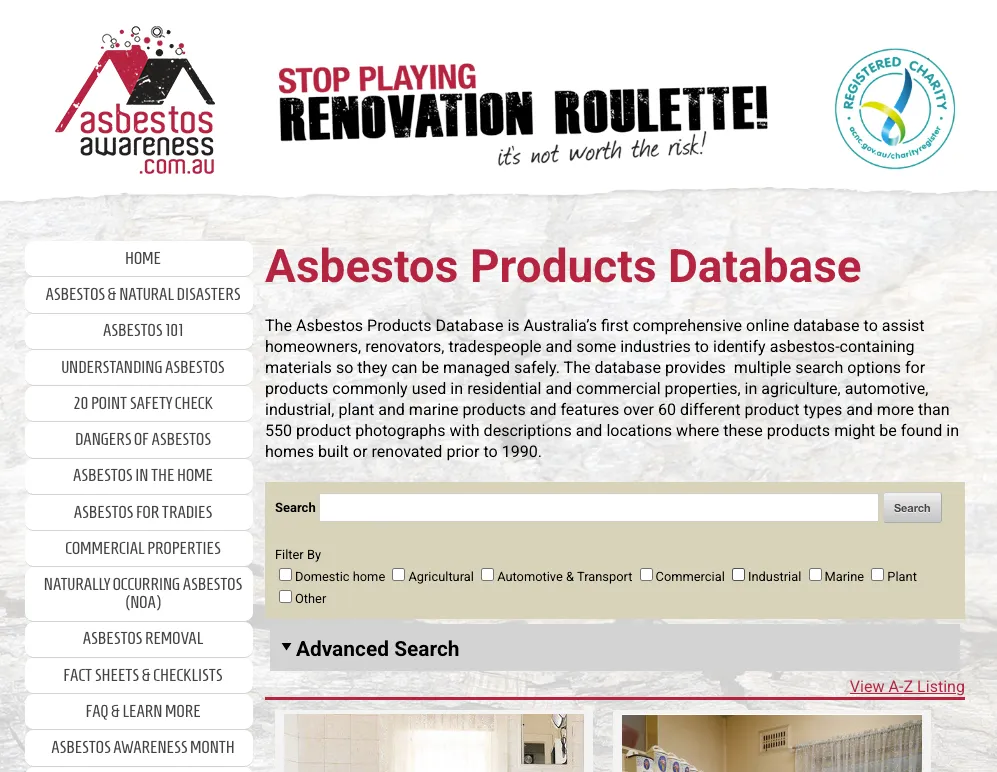
The Asbestos Products Database calls itself “Australia’s first comprehensive online database” of asbestos-containing materials. Its job is simple. It helps people identify these materials so they can manage them safely. The collection spans more than 60 product types and over 550 product photographs. Each entry shows where the material typically turns up in homes built or renovated before 1990.
The Asbestos Education Committee runs the tool through asbestosawareness.com.au, Australia’s main public hub for asbestos safety. The site treats the catalogue as one part of a wider mission. Spokespeople such as Clare Collins and renovation expert Cherie Barber front the campaign each year during Asbestos Awareness Week. The goal stays constant: stop people from disturbing asbestos by accident.
How the Asbestos Products Database Works
I worked through the database directly, and the design clearly favours speed over polish. A single search box sits at the top. Type a room or material — say, “bathroom” — and matching results appear straight away. You can also browse the full A–Z product listing if you would rather scan than search.
Filters narrow things quickly. You can sort results by setting:
- Domestic home
- Agricultural
- Automotive and transport
- Commercial
- Industrial
- Marine
- Plant
- Other
An advanced search adds three sharper controls. You can filter by asbestos fibre type, by friable or non-friable status, and by construction period — from pre-1900 right through to today. The friable filter matters most. Friable materials crumble easily and release fibres with little effort, so that single field flags the higher-risk products fast.
Here is how a real lookup plays out. Click “Bathrooms,” and the database returns matching products. One result is Tilux, a wet-area fibrous asbestos cement sheet once common in Australian bathrooms. Open “View product,” and a full profile loads.
That profile is the database’s strongest feature. A single entry packs in:
- Product photo and description
- Product type and sub-product type
- Trading names and other names
- Building element and identification notes
- Known uses
- Asbestos fibre type and friable status
- Known suppliers and place of manufacture
- Date or period of manufacture and building construction period
- Location and additional images
You can download the whole record as a PDF. For a tradie on site or a homeowner planning a weekend job, that one-page summary is genuinely useful.
Why the Asbestos Products Database Matters
Australia carries one of the heaviest asbestos legacies in the world. We were among the highest consumers of asbestos-containing materials per head, and the bill is still coming due. The Australian Institute of Health and Welfare’s Mesothelioma in Australia 2024 report recorded 684 new mesothelioma diagnoses in 2024 — about two people every day. The same report logged 688 deaths from the disease in 2023.
The timing makes prevention urgent. Mesothelioma has a long latency, often 20 to 60 years between exposure and diagnosis. Many people now falling ill were exposed decades ago, sometimes as children on a family building site. The Asbestos Education Committee estimates that asbestos-related diseases claim around 4,000 Australian lives each year.
The risk has not retired with the 2003 ban. Australia banned asbestos at the end of 2003, but the material still sits in our walls, roofs, and sheds. The campaign reports that asbestos may lurk in roughly one in three Australian homes, hidden across more than 3,000 building and decorator products. Any fibro, brick, weatherboard, or clad home built before 1990 could contain it.
The principle is simple: if a home predates 1990, treat suspect materials as asbestos until a licensed professional proves otherwise.
Most of that material stays low-risk while it sits undisturbed. The danger starts the moment someone cuts, drills, or sands it during a renovation. A database that links a suspicious tile or sheet to a known product gives people a vital head start before they pick up a tool.
Who Uses It, and the Problem It Solves
The audience is broad, but a few groups lean on it most:
- Homeowners and DIY renovators checking a material before they disturb it
- Tradies — electricians, plumbers, builders — who meet old materials on the job
- Property managers and landlords assessing ageing buildings
- Assessors and inspectors who want a quick visual reference
The database solves one precise problem. It connects a physical material to its likely identity and risk profile. It does not replace lab testing. Instead, it does something earlier in the chain. It helps a person know when to stop and call in a licensed assessor.
How It Differs From Other Asbestos Resources
Plenty of websites explain what asbestos is. Very few show you the actual products. That is what sets this catalogue apart. It pairs photographs with named products, suppliers, and locations, so identification becomes visual rather than abstract.
It also sits inside a deeper resource set. The same site hosts checklists, fact sheets, and trade-specific guides, so a search result can lead straight into safe-handling advice. Asbestos straddles environmental health, public safety, and corporate accountability — the same themes that drive many environmental, social and governance databases. A free, open product catalogue reflects a transparency value that few private registries match.
The Limits of the Asbestos Products Database
Honesty matters with a safety tool, so weigh the weaknesses plainly.
It is not a diagnostic tool. A visual match is a clue, not a confirmation. Only a NATA-accredited lab can verify asbestos content. The database itself steers users toward licensed assessors, which is the responsible call.
Coverage has gaps. The catalogue holds 60-plus product types and 550-plus photos. Manufacturers, though, produced thousands of asbestos products across the decades. No single catalogue captures them all, so a missing match never means “all clear.”
Sourcing transparency is thin. Each entry reads as authoritative, yet the database rarely shows where a specific detail came from. For a reference tool, clearer provenance on each field would lift trust further.
Currency is hard to judge. Product histories and supplier records date back many decades. Users cannot easily tell when an entry was last reviewed or updated.
Transparency, Accuracy and Privacy
On transparency, the database scores well. It is free, it asks for no account, and it opens its full catalogue to anyone. That openness is rare for safety data of this depth.
On accuracy, the tool stays in its lane. It describes and illustrates; it does not certify. By pushing users toward professional testing, it sidesteps the trap of false certainty. That restraint protects people.
On privacy, there is little to worry about. The database is a reference catalogue, not a registry of people or properties. Users browse products, not personal records, and no one has to hand over personal data to use it.
When the Asbestos Products Database Is Genuinely Useful
A few real situations show its value clearly:
- Before a renovation. You spot old vinyl tile or pipe lagging and want a name for it before you touch it.
- When buying an older home. You walk a 1960s fibro house and flag materials worth raising with an inspector.
- On a job site. A tradie meets an unfamiliar sheet material and pulls up a likely match in seconds.
- For learning. A student, apprentice, or new assessor learns what these products actually look like.
In each case, the database does the same quiet job. It turns “I’m not sure what this is” into “I think this might be asbestos — time to test it.”
The Bottom Line
The Asbestos Products Database is a focused, well-built public safety tool. It will not name the exact brand inside your wall, and it cannot replace a lab. It will, however, teach you what asbestos products look like and when caution is warranted. Paired with a licensed assessor, it becomes a smart first step rather than a final answer. For a free resource built around saving lives, that is a strong record — and one more reason to never gamble with a pre-1990 renovation.
Sources
- Asbestos Products Database — Asbestos Awareness (Asbestos Education Committee)
- Asbestos Products Database A–Z Listing
- Australian Institute of Health and Welfare — Mesothelioma in Australia 2024
- Asbestos Education Committee — Asbestos Awareness Week media release
- Asbestos Awareness — asbestosawareness.com.au

