


Somewhere in a 650-year-old pay record, an ordinary English archer is waiting to be found. No chronicle mentions him, and no king knew his name. Yet a royal clerk wrote that name down, because the Crown paid him to fight. As a result, the Medieval Soldier Database now puts that clerk’s ledger one search box away. For anyone tracing English ancestry, or simply curious about who really filled medieval armies, it ranks among the most remarkable free history tools on the web.
This is not a polished consumer product with hint icons and shaking leaves. Instead, it is a serious academic resource that exposes raw, primary-source military records. That openness makes it powerful. However, it also means you need to know how to work it. Below, you will find what the database holds, who relies on it, where it falls short, and exactly how to search it.
What the Medieval Soldier Database Actually Is
The full title is The Soldier in Later Medieval England, and the research team launched it back in 2009. It grew out of a major project funded by the Arts and Humanities Research Council, led by Professor Adrian Bell at the University of Reading and Professor Anne Curry at the University of Southampton. Their aim was clear. Essentially, they wanted to challenge the old idea that medieval armies were ragtag feudal levies, and to show what soldiering careers really looked like.
Since then, the dataset has grown steadily. It started with about 250,000 service records. Today, by contrast, it holds close to 290,000 entries, after new material pushed the coverage back to the late 1350s. The core period runs from 1369 to 1453, namely the later phase of the Hundred Years War. Moreover, the University of Southampton’s GeoData Institute now hosts the resource for the long term, and the project team reports roughly 75,000 visitors every month.
Importantly, the records come from primary sources rather than secondary retellings. Most entries draw on muster rolls held at The National Archives in Kew. Others come from the musters of English garrisons in France, from letters of protection bought by men heading overseas, and from the Agincourt roll. In short, you are reading the medieval state’s own paperwork, indexed and made searchable.
Why This Medieval Soldier Database Matters
Most family trees eventually hit a wall. Parish registers in England begin only in 1538, so push earlier and the paper trail thins out fast. The Medieval Soldier Database, however, reaches into a period that almost no ordinary genealogy can touch. Better still, it does not just list nobles and kings. Instead, it records men-at-arms and archers by name, namely the working soldiers of the age.
It also solves a research problem that used to cost weeks of travel. Previously, finding one soldier meant visiting archives in England and France, reading Latin and French by hand, and decoding unstandardized spelling. Now the database pulls those scattered manuscripts into a single search. As the project leads explained in The Conversation, the records reveal repeat-service careers, social mobility, and the surprising humanity of medieval armies.
A single record can also open a story. Take Thomas Crowe of Snodland in Kent, for example, accused during the Peasants’ Revolt of 1381 of hurling great stones to demolish a house. According to the database, he may have served in France and later joined the Calais garrison and a naval campaign in the 1380s. Consequently, his knowledge of siege weapons may explain the damage he caused at home. The muster roll for the Calais garrison in 1357 even lists the support trades behind an army: mason, fletcher, bowyer, blacksmith, cooper, and a tiler named Walter Tyler. That last detail raises a tantalizing question about the later rebel leader Wat Tyler.
Who Uses It
The audience is broader than you might expect. In practice, the regular users include:
- Family historians and genealogists, including many Americans with English, Welsh, Scottish, or Irish roots, who want to extend a tree past the 16th century.
- Academic and military historians, who study army organization, recruitment, and the rise of England’s first professional soldiery.
- Students and teachers, who prefer real primary-source data to textbook summaries.
- Citizen historians and volunteers, who have helped build detailed soldier profiles over the years.
- Novelists, re-enactors, and name researchers, who chase authentic period detail.
How to Search the Medieval Soldier Database
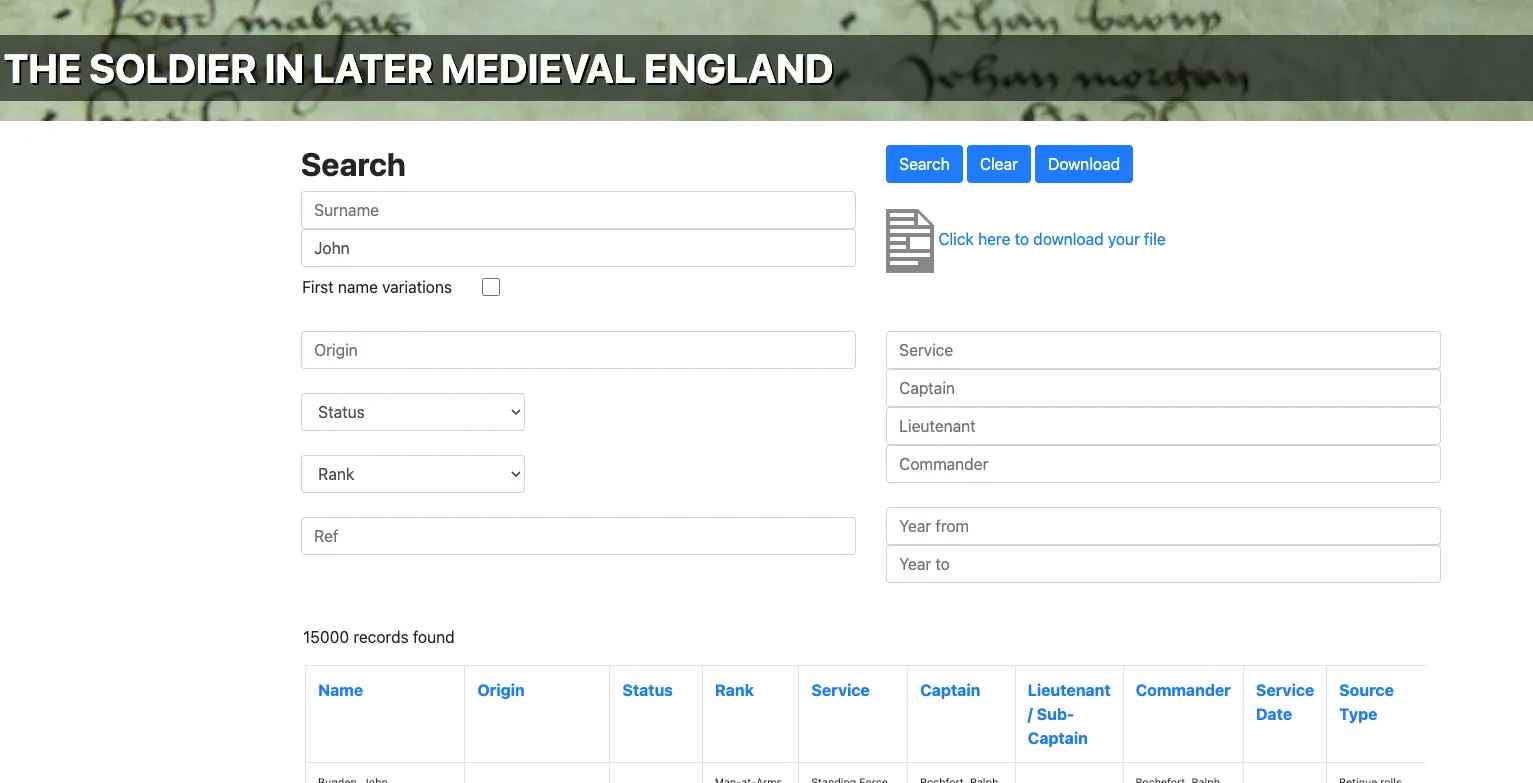
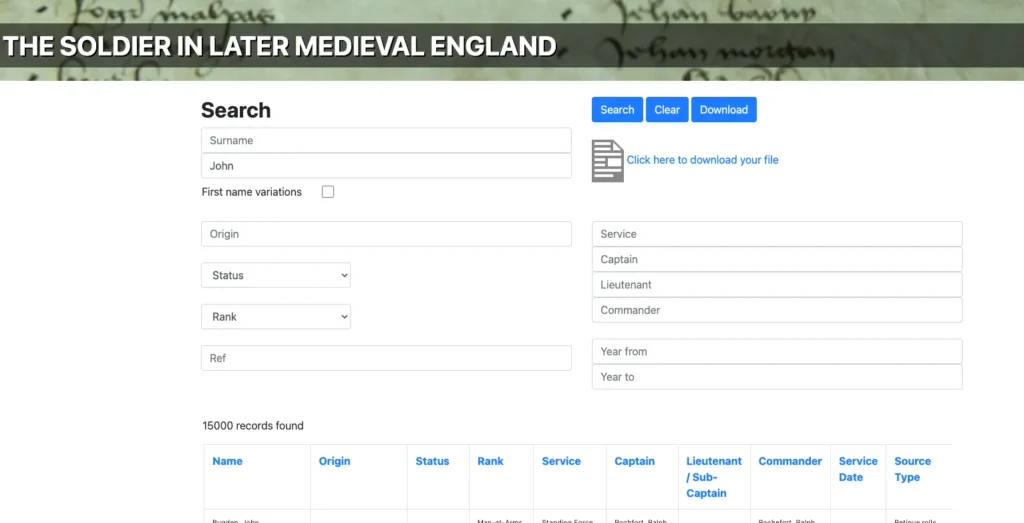
Fortunately, the interface is plain, and that simplicity is a strength. The database search page gives you fields for Surname, First name (with a “first name variations” checkbox), Origin, Status, Rank, Ref, Service, Captain, Lieutenant, Commander, and a Year from / Year to range. From there, you hit Search, use Clear to reset, or choose Download to export.
A Worked Example: Searching for “John”
Here is how it behaves in practice. First, type a common first name like John and run the search. Almost instantly, the results table fills. For example, one row returns John Bugden, listed as a Man-at-Arms in a standing force in France, serving under Captain Sir Ralph Rochfort, and drawn from retinue rolls. In total, the columns you get back are Name, Origin, Status, Rank, Service, Captain, Lieutenant / Sub-Captain, Commander, Service Date, Source Type, and Reference. Afterward, you can click to download your file as a CSV and analyze it in a spreadsheet, which is rare for a free academic tool.
Search Tips That Save Time
A few practical habits make a real difference:
- Use wildcards. By default, the search wants an exact match. Searching “Fitz”, for instance, returns only people surnamed exactly Fitz. Instead, use Fitz* to catch every surname that starts that way. The system also accepts * and % for any number of letters, plus ? or _ for a single character.
- Turn on first-name variations. Medieval clerks wrote the same name many ways. Therefore, the variations option links forms like Guillaume and Wilkin back to William.
- Think phonetically with surnames. Spelling was not fixed. Taillour stands in for Taylor, Smith and Smyth swap freely, and French clerks in Normandy often spelled English names by ear.
- Mind the result cap. Each query returns at most 15,000 records. Consequently, broad searches hit that ceiling, so narrow them by rank, year range, or captain.
For a deeper walkthrough, the project’s own how-to-search guide explains the fuzzy-matching rules and naming conventions in detail. In addition, if you are building a wider research toolkit, it pairs well with other free educational and research databases that cover archives and public records.
Limitations You Should Know
Of course, no serious resource is flawless, and honesty here saves you frustration.
First, this is an index of names, not a biography service. Many records carry little beyond a name, a rank, and a campaign. In our John Bugden example, for instance, the Origin and Status columns sat empty, which is common.
Second, identification is hard. Surnames were not always inherited, spelling drifted, and several different John Greens could appear in the same decade. So finding a “John Bell” in 1414 is exciting, yet it remains a lead rather than proof of your ancestor.
Third, the captain, lieutenant, and commander columns use standardized, “highest” titles. John Talbot, for example, always appears as earl of Shrewsbury, even for service years before he actually held that title. Therefore, search those fields with that quirk in mind.
Finally, the sources are not all equal. Letters of protection often show an intention to serve rather than confirmed service, so treat that source type with care. For broader context, The National Archives’ own research guide on medieval soldiers explains what these documents can and cannot prove.
Transparency, Accuracy, and Privacy
On transparency, the database scores high. Because it is free, openly accessible, and tied back to archival references, you can chase any entry to its original document at Kew. Furthermore, the CSV export lets you audit and reuse the data yourself. By contrast, paywalled commercial genealogy platforms rarely offer that kind of openness.
Privacy, meanwhile, is not a concern. These records are 570 to 670 years old, so no living person’s data is at stake. Instead, the real questions involve accuracy: transcription errors, ambiguous identities, and the gaps left by muster rolls that simply did not survive. Reassuringly, the team treats the project as ongoing and keeps refining and expanding it, which is exactly what you want from a credible research resource.
Ultimately, the Medieval Soldier Database will not hand you a tidy family tree. What it offers is better. In the end, it hands you the raw evidence of real lives, along with the tools to read it for yourself.
Sources
- The Soldier in Later Medieval England — Database
- The Soldier in Later Medieval England — How to Search
- The Conversation — We built a database of 290,000 English medieval soldiers
- University of Southampton — Medieval soldier service records published online
- The National Archives — Medieval and early modern soldiers research guide
This article was created with AI assistance and reviewed by a human editor.

