


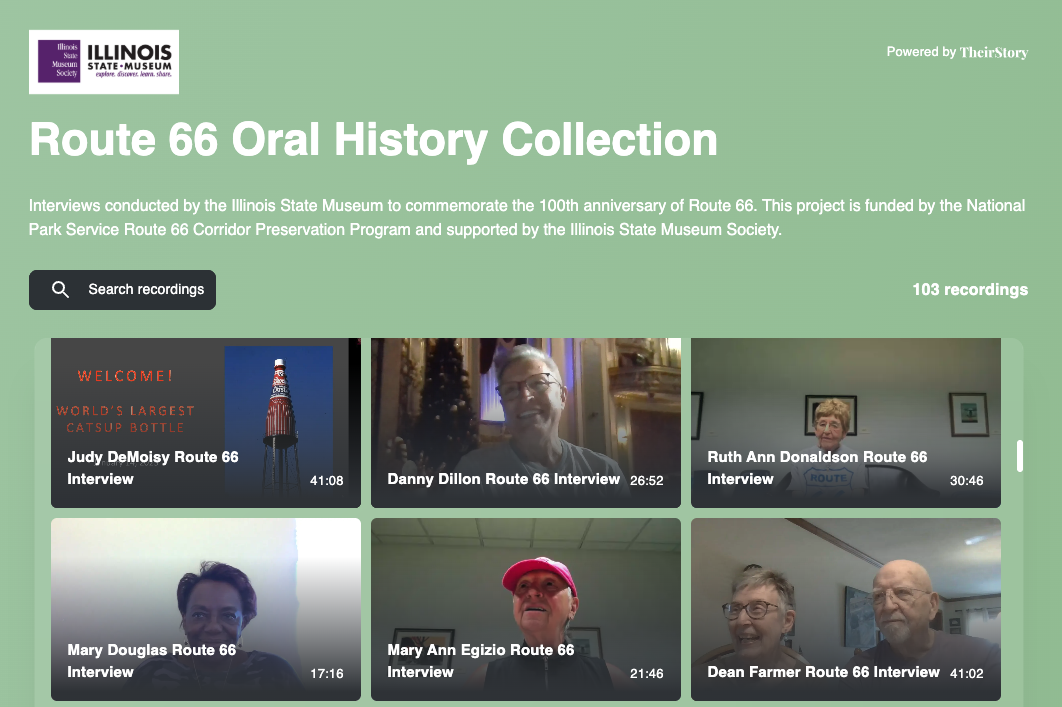
Most Americans know Route 66 from bumper stickers and road trip playlists. Far fewer know that a publicly funded institution has spent two years quietly recording the people who actually lived, worked, and drove it — and has now made those recordings searchable online, for free. The Route 66 Oral History Database, launched by the Illinois State Museum in late 2025, is one of the more quietly ambitious open history databases to appear in recent years. It arrives just in time for the road’s centennial in 2026 — and it’s more useful than its low-key launch might suggest.
A Road That Never Really Disappeared
The Route 66 Oral History Database is a niche resource. It complements broader histories of Route 66 rather than replacing them. For decades it was the primary artery connecting the American Midwest to the West Coast — a lifeline during the Great Depression for families moving west, a critical supply corridor during World War II, and later, the physical backdrop for postwar optimism and car culture. John Steinbeck called it “the Mother Road” in The Grapes of Wrath, and the name stuck.
The federal government decommissioned Route 66 in 1985, replaced by the interstate highway system. But the road never left the cultural imagination. Today, Route 66 attracts millions of visitors each year as a heritage tourism route. Preservation groups, state agencies, and the National Park Service actively document and preserve what remains of the historic roadway.
With the centennial approaching, the Illinois State Museum recognized a narrowing window: the people who remember Route 66 in its working prime are aging. The decision to systematically record their stories — and make those recordings searchable — was both historically sound and practically urgent.
What the Route 66 Oral History Database Actually Contains
The database currently holds 103 recorded interviews, slightly more than the 100 originally announced. Each entry consists of a video recording and a full written transcript. Interviews range from under half an hour to well over two hours — Polly Myers’ session runs nearly 1 hour 41 minutes, Jim Marcacci’s exceeds two hours. The collection was recorded between 2024 and 2025 by museum team members and is hosted on the TheirStory platform.
The subjects are deliberately varied. Some lived along the route during the pre-interstate decades. Others operated businesses, worked in law enforcement, or traveled it regularly. A significant portion of the interviewees are people currently active in Route 66 preservation, promotion, and tourism — giving the collection both a retrospective and a contemporary dimension.
Funding came from two sources: the National Park Service’s Route 66 Corridor Preservation Program and the Illinois State Museum Society. That public funding model matters — it’s part of why the collection is fully open to the public at no cost.
How the Route 66 Oral History Database Search Works
This is where the database earns its usefulness. The TheirStory platform includes a “Search recordings” function that searches keyword terms across the written transcripts of all 103 interviews simultaneously. In practice, this means you can type “Green Book” and surface every interview in which that subject came up — without watching hours of video to find the relevant passage.
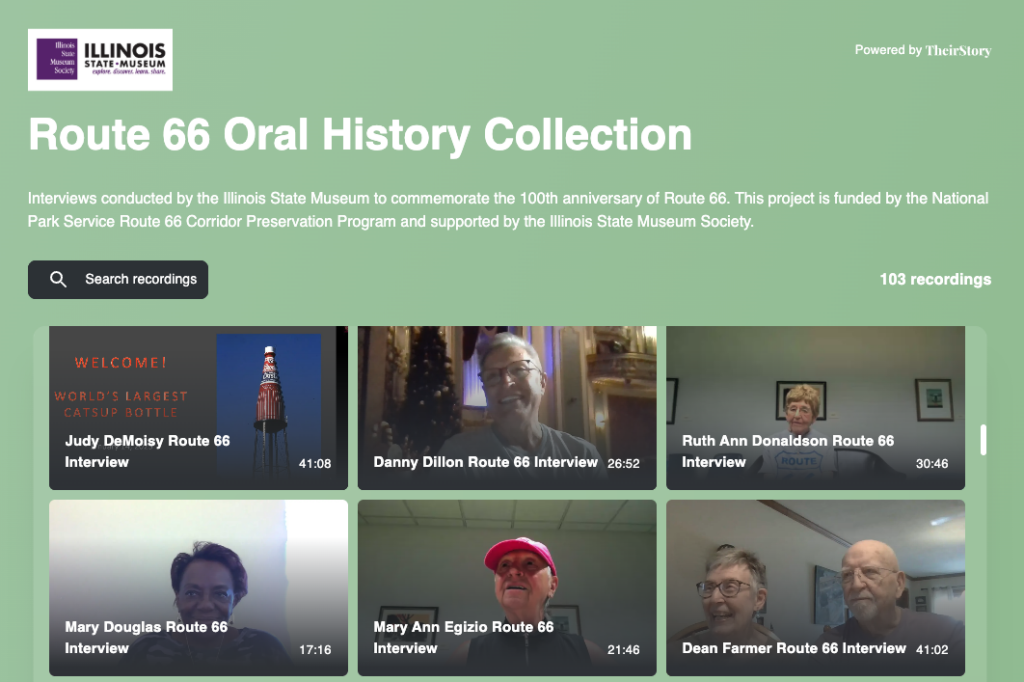
The Illinois State Museum’s own documentation suggests a useful list of starting search terms: accommodations, California, eating, gangsters, Great Depression, Great Migration, Green Book, historic preservation, hitchhiking, mishaps, music, roadside attractions, safety, tourism, working, World War II. That list alone hints at the thematic depth sitting inside this collection.
In practice, the search function is straightforward to use. There’s no complex query syntax required — enter a word or phrase, and the database surfaces all interviews where that term appears in the transcript, with the relevant passages highlighted. For researchers accustomed to digging through unindexed audio archives, this is a significant functional advantage. The kind of keyword-searchable transcript access this database offers is exactly what separates a genuinely usable open resource from a digital filing cabinet. If you want a broader view of what well-structured open databases look like across different domains, the free and open databases directory at TheDatabaseSearch.com offers useful comparative context.
Who Should Use This Database
The obvious audience is historians and academic researchers. Oral history collections are primary sources, and this one covers a subject — Route 66’s social and cultural history — that intersects with American studies, transportation history, labor history, and the history of race and migration. The Green Book references alone could anchor serious scholarly work: the Green Book was the travel guide used by Black Americans during segregation to navigate safe stops along routes like Route 66, and its mention across multiple interviews opens up questions about how differently various communities experienced the same road.
Beyond academia, the database has clear value for:
- Educators — primary source material on the Great Depression, WWII homefront, postwar America, and civil rights-era travel, all in accessible video and transcript form
- Journalists and documentary filmmakers — a searchable archive of first-person accounts that would otherwise require individual outreach to find
- Route 66 enthusiasts and road trip planners — detailed personal accounts of specific towns, businesses, and landmarks that no guidebook contains
- Genealogists — families with Route 66 connections may find direct references to relatives, towns, or businesses their ancestors were associated with
- Preservation organizations — documentation of what existed, how it functioned, and what’s been lost provides evidence useful for heritage designation and restoration efforts
How It Compares to Other Oral History Archives
Oral history archives are not new. The Library of Congress Veterans History Project holds tens of thousands of first-person accounts. StoryCorps has recorded over 700,000 conversations. The Smithsonian’s various oral history initiatives cover broad swaths of American cultural life.
What distinguishes the Route 66 collection is its tight thematic focus, full transcript availability, and keyword searchability. Together, these features make the archive easier to navigate and use. Many institutional oral history archives provide recordings but not searchable transcripts. As a result, users often need to know exactly which interview they want before they can locate useful information. This database inverts that: the search function is designed to help you discover relevant material you didn’t know existed.
The thematic specificity is also a genuine asset. All 103 interviews focus on the same road, time period, and cultural context. This shared focus creates valuable connections across the collection that broader archives often lack. When multiple interviewees independently describe the same diner, stretch of road, or historical moment, those convergences carry evidential weight.
Limitations and Gaps Worth Knowing
No database is without its constraints, and this one has several worth naming explicitly.
Geographic scope is limited to Illinois. Route 66 passed through eight states: Illinois, Missouri, Kansas, Oklahoma, Texas, New Mexico, Arizona, and California. The Illinois State Museum produced this collection. While it includes interviewees from beyond Illinois, its institutional focus remains centered on the state. As a result, perspectives from communities in New Mexico, Arizona, and California are less represented.The road’s history looks different depending on where you stood on it.
Interview length and depth may vary. Some recordings provide broad life histories, while others focus on narrower memories, places, or themes. For that reason, users should treat the database as a curated oral history collection rather than a uniform set of standardized interviews.
No subject or topic filtering. The database is organized alphabetically by interviewee name. There’s no way to filter by topic, time period, geographic focus, or demographic. The keyword search partially compensates for this, but a researcher interested specifically in women’s experiences on Route 66, or in perspectives from Black travelers, has to rely entirely on search terms to surface relevant material — there’s no structured navigation path.
Platform dependency is a long-term question. The collection is hosted on TheirStory, a third-party platform. The Illinois State Museum’s own page links out to that platform rather than hosting the material directly. This is a common and practical arrangement, but it raises questions about long-term preservation: what happens to the collection if the platform changes its terms, pricing, or ceases to operate? Institutional oral history collections have been lost before when the organizations hosting them folded or migrated systems poorly.
Transcript accuracy varies. Auto-generated or lightly edited transcripts — common in this type of project — can contain errors, particularly with proper nouns, place names, and dialect. The database doesn’t appear to specify its transcription methodology. For casual use this is rarely a problem; for citation-dependent academic work, cross-referencing with the video source is advisable.
Transparency and Preservation Value
One thing the Illinois State Museum has done well is articulate the terms of use clearly. The collection is open for personal, educational, and non-commercial use under fair use principles. Researchers are asked to cite the Illinois State Museum as the repository, with a suggested citation format provided directly on the project page. That kind of explicit guidance is more useful than the vague “contact us for permissions” language that buries access in many institutional archives.
The public funding model also matters here. A project backed by the National Park Service and a state museum society has an implicit accountability to public access that commercially funded archives don’t share. The decision to use a platform that makes the collection freely browsable — rather than gating it behind an institutional login — reflects that orientation.
For other state museums and heritage organizations considering oral history projects, this collection offers a practical model. Its scope is manageable, with 103 interviews that many institutions could realistically produce. The project is also technically accessible. Searchable transcripts are its most useful feature and help distinguish it from many traditional oral history archives. Just as importantly, the collection is tied to a culturally significant milestone. The Route 66 centennial provides both urgency and a built-in audience.
The Bigger Picture
The Route 66 Oral History Database is a niche resource. It will not replace a comprehensive history of the road, nor is it intended to. Instead, it preserves something that might otherwise be lost. The collection captures personal memories from people who experienced Route 66 as a lived reality rather than a cultural symbol. Many of those memories are detailed, subjective, and sometimes contradictory.
That kind of preservation work is one of the strengths of open databases. The collection adds to a growing body of publicly accessible primary source material. Researchers, educators, and history enthusiasts can explore the interviews without cost or institutional affiliation. Anyone interested in twentieth-century American history, road culture, or the social history of Route 66 is likely to find valuable material here. The database may not be comprehensive, but it offers a perspective that traditional historical accounts often cannot provide.
The centennial is in 2026. The people who remember the road are still here. The database is open now.
Sources
- Route 66 Oral History Collection — TheirStory (Illinois State Museum)
- Illinois State Museum — Route 66 Oral History Project
- WAND TV — Illinois State Museum Launches Online Database of 100 Oral Histories of Route 66
- National Park Service — Route 66 Corridor Preservation Program
This article was created with AI assistance and reviewed by a human editor.

