


The eDNAmap Database offers something different from a typical biodiversity database. Instead of relying only on species that researchers physically observe, collect, or photograph, it helps scientists explore marine life through traces of DNA left behind in seawater.
That matters because the ocean is difficult to monitor. Many species are hard to see, expensive to survey, or present only briefly in a sampled area. Environmental DNA, or eDNA, gives researchers another way to investigate marine biodiversity without directly capturing organisms.
The eDNAmap Database turns that science into a searchable, map-based platform. It brings together marine eDNA datasets, project information, species-level results, comparison tools, and downloadable outputs in one place.
What Is the eDNAmap Database?
The eDNAmap Database is a public online platform for exploring marine environmental DNA data. The database is available through the official eDNAmap web interface and is supported by a detailed eDNAmap user instruction guide.
The platform is also described in a peer-reviewed article published in Molecular Ecology Resources. Its code and related development materials are available through the project’s GitHub repository, which adds an important open-science layer to the project.
In practical terms, eDNAmap is not just a static data archive. It is a working research interface where users can search, map, compare, and export marine biodiversity information.
Why Environmental DNA Matters
Environmental DNA refers to genetic material that organisms release into their surroundings. In marine environments, fish and other organisms leave DNA behind through mucus, waste, skin cells, scales, eggs, and other biological material.
Researchers collect water samples, analyze the DNA, and compare the sequences against reference databases to infer which organisms may be present.
This approach is valuable because it can help detect:
- rare species
- invasive species
- hard-to-observe marine organisms
- biodiversity changes over time
- species presence in remote or difficult sampling locations
For marine science, eDNA is especially powerful because traditional surveys can be expensive, slow, and incomplete.
How the eDNAmap Database Works
One of the strongest parts of the eDNAmap Database is that it does not force users to start from a blank search box.
On the homepage, users can immediately browse available projects through the “and/or choose projects from the database” section. This makes the database easier to understand even before running a search.
The available project information includes:
- search area
- habitat
- organism
- metabarcoding
- table
- cruise
- article
This is useful because it gives readers a quick sense of what kind of data exists inside the platform.
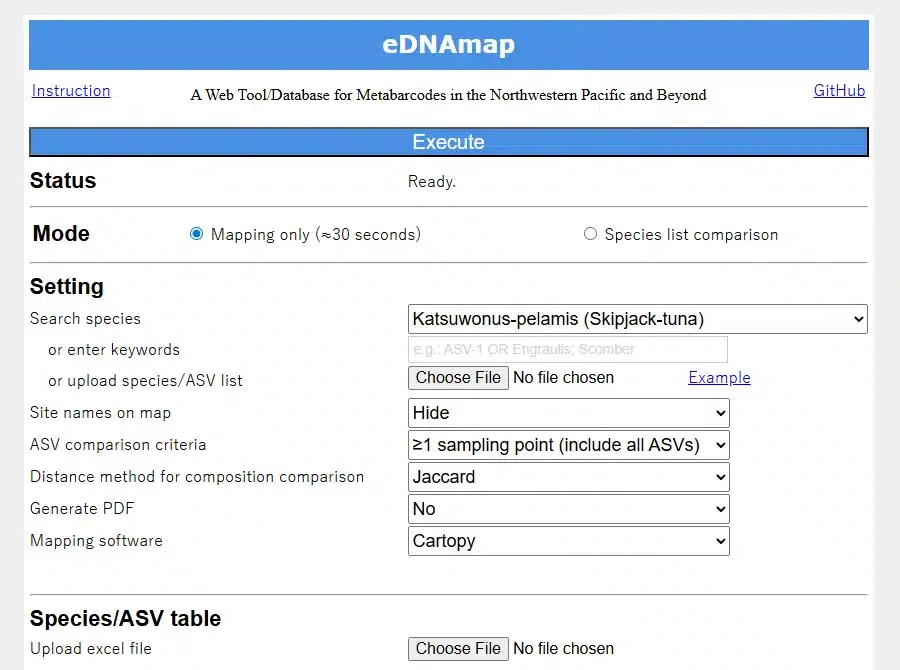
The database also includes several working modes and settings, including:
- Mapping only mode, which can generate maps in about 30 seconds
- Species list comparison
- species or keyword search
- species/ASV list upload
- site names on map
- ASV comparison criteria
- distance method for composition comparison
- PDF generation
- mapping software settings
The official eDNAmap instruction page explains these functions in more detail.
Species/ASV Table Function
A particularly useful feature is the Species/ASV table function.
ASV means Amplicon Sequence Variant. In simple terms, ASVs allow researchers to work with highly specific DNA sequence differences found in environmental samples.
The Species/ASV table can help researchers review what species or sequence variants appear in the database. For users with their own data, the ability to upload species or ASV lists makes the platform more than a browsing tool. It becomes a comparison environment.
That is important because many scientific databases only let users retrieve existing records. eDNAmap also helps users compare their own biodiversity lists against available database records.
What Makes the eDNAmap Database Useful?
The database is useful because it connects several tasks that are often separated across different tools.
A researcher can:
- browse existing marine eDNA projects,
- inspect project-level data,
- view sampling locations on maps,
- compare species lists,
- generate PDF outputs,
- open detailed linked records,
- access related publications and project metadata.
During review, the interface felt relatively easy to explore. The search function is straightforward, and the homepage already exposes available project records before the user enters a query.
The detailed records are also valuable. By clicking links inside the database, users can access richer information, including maps and project-specific data.
For TheDatabaseSearch readers, this is one of the main reasons the platform is worth covering: it is not only a database name mentioned in a research paper. It is an actual public interface with searchable and explorable data.
Who Uses the eDNAmap Database?
The eDNAmap Database is most relevant for scientific and environmental users, including:
Marine Scientists
Marine ecologists can use eDNAmap to explore species distributions, compare sampling areas, and review biodiversity patterns across projects.
Conservation Researchers
Conservation teams can use eDNA data to study marine protected areas, biodiversity loss, invasive species, and ecosystem recovery.
Fisheries Analysts
Fisheries researchers may use eDNA information to complement traditional fish surveys, especially where direct observation is limited.
Students and Educators
Because the database includes maps and public project records, it can also support teaching. Students can see how modern biodiversity monitoring works using real eDNA data.
Data Journalists and Policy Researchers
For researchers who follow environmental transparency and open science, eDNAmap is also interesting as an example of how complex scientific datasets can be made more accessible.
Readers interested in other public research tools may also find TheDatabaseSearch guides to science databases useful.
How the eDNAmap Database Differs From Traditional Biodiversity Databases
Traditional biodiversity databases often rely on direct observation, museum specimens, or field survey records.
The eDNAmap Database is different because it focuses on DNA-based environmental detection.
| Traditional biodiversity databases | eDNAmap Database |
|---|---|
| Based mainly on observed or collected organisms | Based on environmental DNA signals |
| Often record-focused | Map- and comparison-focused |
| Usually static | Interactive and analytical |
| May require outside GIS tools | Includes mapping features |
| Often difficult for non-specialists | Easier homepage browsing and project selection |
This does not mean eDNAmap replaces traditional biodiversity databases. Instead, it complements them.
A fish seen during a survey and a fish detected through eDNA are not exactly the same type of evidence. Both matter, but they must be interpreted differently.
Why the eDNAmap Database Matters
The database matters because eDNA research is growing quickly, but the data can be difficult to organize and reuse.
Marine biodiversity information often ends up spread across journal articles, supplementary files, institutional repositories, and project websites. That fragmentation makes it harder for researchers to compare results across locations or time periods.
The eDNAmap Database addresses this problem by putting project records, map views, species data, comparison tools, and publication links into one public platform.
This creates value for:
- biodiversity monitoring
- marine conservation
- environmental research
- fisheries management
- climate-related ecosystem studies
- open science and reproducibility
For a North American audience, the broader point is especially relevant. Ocean monitoring increasingly depends on tools that can combine field sampling, molecular biology, mapping, and public data access.
Transparency and Open Science Value
One of the most important strengths of eDNAmap is transparency.
The database is publicly accessible through the official eDNAmap platform. Its methods and scientific framing are documented in the peer-reviewed Wiley article. The availability of the GitHub repository also supports reproducibility and technical review.
That combination matters.
A database is more trustworthy when users can understand where the data comes from, how the system works, and what assumptions sit behind the interface.
For open science, eDNAmap is a strong example of a research platform that does not hide behind a paper alone. It gives users a working tool.
Limitations and Data Quality Questions in the eDNAmap Database
The eDNAmap Database is useful, but it should not be treated as a perfect window into the ocean.
Environmental DNA has scientific limitations.
DNA Detection Does Not Always Mean Direct Observation
If a species appears in eDNA data, that does not necessarily mean a researcher physically saw the organism at that exact site. DNA can persist in water or move through currents.
Coverage Depends on Available Projects
The database reflects the projects and sampling areas included in the platform. Some regions may be well represented, while others may have little or no coverage.
Interpretation Requires Expertise
Terms such as metabarcoding, ASV comparison, and distance methods may be difficult for general readers. The platform is more accessible than many scientific tools, but it is still designed around research workflows.
Reference Data Still Matters
eDNA identification depends on comparing sequences to known references. If reference databases are incomplete or uncertain, species-level interpretation can be affected.
These limitations do not make the database weak. They make careful interpretation necessary.
Real-World Use Cases
The eDNAmap Database can be useful in several practical situations.
A marine researcher could use it to compare biodiversity patterns between sampling cruises.
A conservation group could use it to explore whether species associated with a protected area appear in available eDNA datasets.
A graduate student could use the Species/ASV table to understand how environmental DNA results are structured.
A data journalist could use the map interface to explain how DNA-based monitoring is changing marine research.
A policy analyst could use the platform as an example of open biodiversity infrastructure.
In each case, the database helps convert highly technical genetic data into something more searchable and visible.
Final Assessment
The eDNAmap Database is a strong candidate for coverage because it is not just a research claim or a downloadable dataset. It is a functioning online database with mapping, search, comparison, and export tools.
Its biggest strengths are:
- easy project browsing from the homepage
- searchable marine eDNA data
- interactive maps
- Species/ASV table functionality
- species list comparison
- linked detailed records
- public documentation
- open-source supporting materials
Its weaknesses are mostly tied to the nature of eDNA science: uneven coverage, interpretation complexity, and dependence on underlying reference data.
Overall, eDNAmap is a valuable example of how modern biodiversity databases are evolving. They are no longer just lists of records. Increasingly, they are analytical environments where users can explore, compare, and question scientific data directly.
For readers interested in marine science, biodiversity monitoring, and open research infrastructure, the eDNAmap Database is worth knowing.
Sources
- eDNAmap Database: https://orthoscope.jp/eDNAmap
- eDNAmap Instruction Guide: https://fish-evol.org/eDNAmap_instruction/
- Molecular Ecology Resources article: https://onlinelibrary.wiley.com/doi/10.1111/1755-0998.70066?af=R
- GitHub Repository: https://github.com/jun-inoue/eDNAmap

