


The Ontario Mortgage Broker Search gives consumers a simple way to verify mortgage brokers, agents, and brokerages before sharing sensitive financial information.
The database is run by the Financial Services Regulatory Authority of Ontario which is also known as FSRA. They are in charge of making sure mortgage brokers in Ontario are doing things right.
FSRA says they make sure licensed mortgage brokerages, brokers, agents and administrators, in the province are following the rules. They also warn people that they can’t protect them if they work with someone who isn’t licensed to help with mortgages.
That makes this database more than a simple directory. It is a public verification tool for a high-trust, high-risk financial service.
What Is the Ontario Mortgage Broker Search?
The Ontario Mortgage Broker Search is a public licensing database that allows users to check whether a mortgage professional or mortgage business is licensed in Ontario.
The database covers three main search categories:
- Agent or Broker
- Mortgage Brokerage
- Mortgage Administrators
This distinction matters. A consumer may be dealing with an individual mortgage agent, a licensed mortgage broker, the brokerage that sponsors them, or a mortgage administrator involved in managing mortgage investments or related arrangements.
According to FSRA’s mortgage brokering sector information, mortgage brokers, agents, brokerages, and administrators must be licensed to deal or trade in mortgages throughout Ontario. In simple terms, the database helps users confirm whether a person or company appears in the regulator’s licensing records.
Why the Ontario Mortgage Broker Search Matters
Mortgage brokering is built on trust. A borrower may disclose tax returns, employment records, bank statements, credit information, and personal identification documents during the mortgage process. If the person handling that information is not licensed, the consumer may face serious financial and privacy risks.
FSRA’s consumer guidance on mortgage brokering makes the regulatory point clear: consumers should understand who they are dealing with before entering a mortgage transaction.
The Ontario Mortgage Broker Search helps solve several practical problems:
- It allows borrowers to verify a mortgage professional before sharing sensitive information.
- It helps identify the brokerage associated with an agent or broker.
- It provides a quick way to check licence status.
- It gives journalists, researchers, and compliance teams a public source for basic licensing verification.
- It improves transparency in a market where consumers often have less information than industry professionals.
For readers interested in related public tools, The Database Search also maintains a broader collection of resources in its Real Estate Databases category.
How to Search the Ontario Mortgage Broker Search
The database is relatively easy to use compared with many public licensing systems. That is one of its practical strengths.
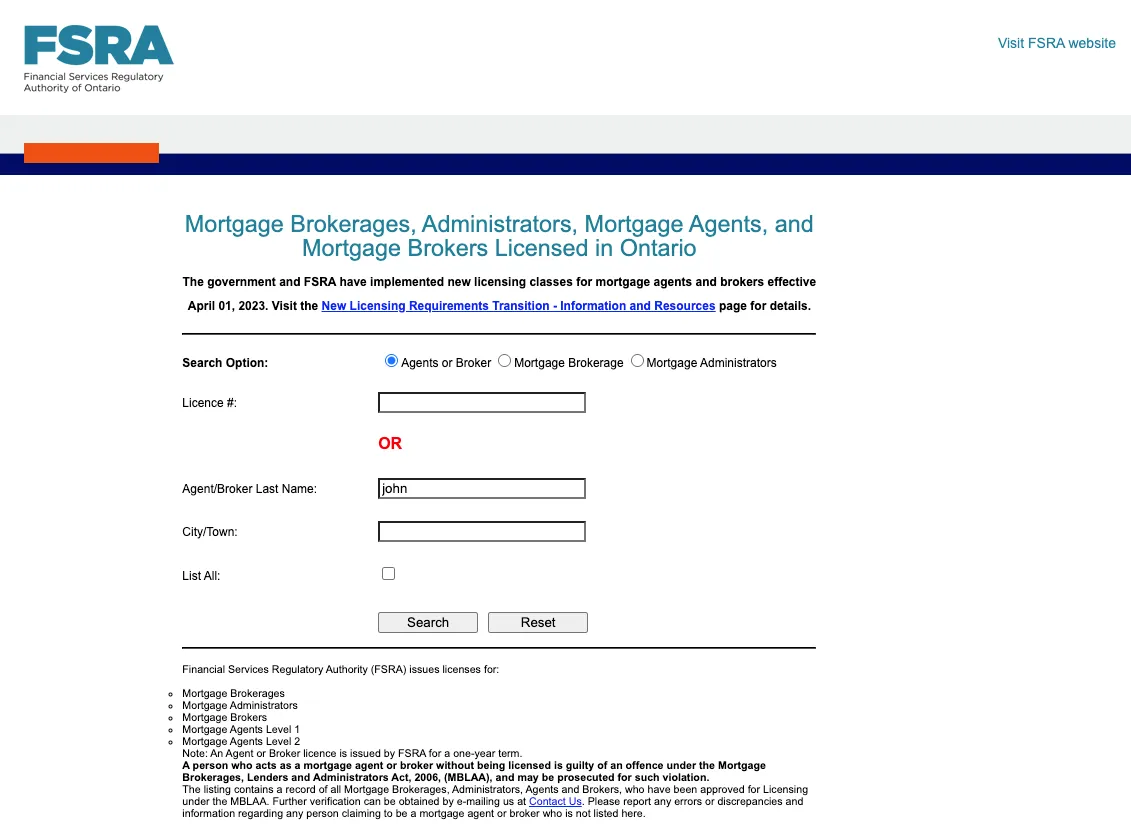
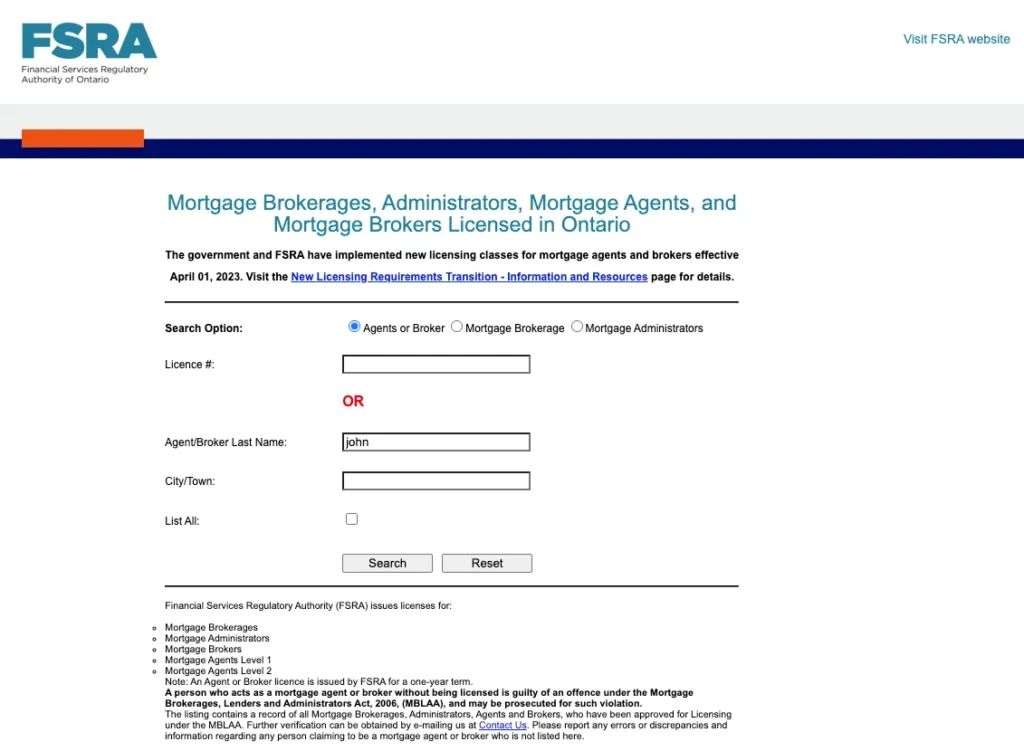
Users can search by selecting one of the available categories:
- Agent or Broker
- Mortgage Brokerage
- Mortgage Administrators
For agents and brokers, the search options include:
- Licence number
- Agent or broker last name
- City or town
- List all
This design is straightforward. If a borrower already has a licence number, the search can be very direct. If not, the last name and city fields can still help narrow the results.
In my view, the database’s biggest usability advantage is that it does not try to do too much on the first screen. Some licensing databases overwhelm users with technical filters, unclear terminology, or multiple agency-specific search paths. This one is more focused. It gives users a few practical search options and lets them get to the licensing record quickly.
What Appears in the Search Results?
After clicking the search button, the database displays a results table with basic identifying information.
The initial search results show:
- Licence
- Name
- City
This first layer is useful for matching the correct person or business, especially when several people have similar names.
When the user clicks the licence number, the database opens a more detailed record. For an agent or broker, the detailed page may show:
- Agent/Broker Name
- Licence
- Brokerage Name
- Licence Class
- Status
- Issue Date
- Expiry Date
These fields are important because a name alone is not enough. A consumer should also look at the licence status, the licence class, and the brokerage relationship.
For example, if someone introduces themselves as a mortgage broker in Toronto, a consumer can search the person’s last name, check the city, open the licence record, and confirm whether the person’s status appears active. That simple step can prevent confusion between a licensed professional, a former licensee, or someone using a similar name.
What the Licence Class Tells You
The licence class is one of the more important fields in the detailed record.
Ontario has updated its mortgage agent and broker licensing framework in recent years. FSRA explains in its guidance on new mortgage agent and broker licensing requirements that licence classes help distinguish different authorization levels, including mortgage agent level 1, mortgage agent level 2, and broker licences.
This matters because not every mortgage professional has the same authority or training requirements. For instance, FSRA’s page on how to become a mortgage agent level 1 explains that individuals acting as mortgage agents in Ontario must be licensed and sponsored by a licensed mortgage brokerage.
A consumer does not need to become a regulatory expert. But they should understand that the licence class is not just a label. It helps describe what type of mortgage activity the person is authorized to conduct.
Who Uses the Ontario Mortgage Broker Search?
The most obvious users are consumers, but the database has value for several groups.
Consumers and Homebuyers
A first-time homebuyer can use the database before meeting a mortgage agent. A homeowner refinancing a mortgage can use it before sending income documents. Someone considering a private mortgage can use it to verify whether the professional involved is licensed.
This is especially important in situations where the mortgage process feels informal: referrals from friends, social media introductions, private lending discussions, or fast-moving refinancing offers.
Mortgage Professionals
Licensed mortgage professionals can use the database to confirm how their own public record appears. Brokerages may also use it when checking the licensing status of agents, brokers, or competitors.
Compliance Teams
Banks, lenders, law firms, and other businesses involved in mortgage transactions may use public licensing data as part of due diligence. The database is not a full compliance system, but it provides a useful first verification step.
Journalists and Researchers
For journalists and public-interest researchers, the database can help identify licensed actors in Ontario’s mortgage market. It may also support reporting on regulatory trends, market concentration, brokerage networks, or consumer protection issues.
What Problem Does the Ontario Mortgage Broker Search Solve?
The database addresses a classic information imbalance.
Mortgage professionals usually understand the industry better than consumers. They know the terminology, licensing rules, lender relationships, and transaction process. Consumers, by contrast, may only enter the mortgage market a few times in their lives.
A public licensing database narrows that gap.
It gives consumers a way to independently verify a basic but important fact: whether the person or business is listed as licensed by the regulator.
That does not guarantee good service. It does not prove that the broker will find the best mortgage product. But it does establish a regulatory baseline. In a market where a single bad decision can affect a household’s finances for years, that baseline matters.
Transparency Value and Public Accountability
The Ontario Mortgage Broker Search reflects a broader movement toward public access to regulatory data.
FSRA also publishes information through its open data resources, including licensed mortgage brokerages, administrators, agents, and brokers. The purpose is not only administrative convenience. Public access makes licensing information more visible and easier to check.
Transparency has several benefits:
- It helps consumers verify credentials without contacting the regulator directly.
- It discourages unlicensed actors from misrepresenting themselves.
- It gives the public a clearer view of regulated market participants.
- It supports accountability in financial services.
For a mortgage market, this is especially important. Borrowers often make decisions under time pressure. A searchable public database gives them a quick way to pause and verify before moving forward.
Limitations of the Ontario Mortgage Broker Search
The database is useful, but it has limits. Readers should not treat it as a complete background check.
It Is Not a Quality Rating
A licence record does not tell you whether a broker is good at their job. It does not show customer satisfaction, negotiation skill, communication quality, or whether past clients were happy with the outcome.
A licensed mortgage professional can still provide poor service. The database confirms licensing status, not professional excellence.
It Does Not Replace Broader Due Diligence
Consumers should still ask practical questions before choosing a mortgage professional. FSRA’s consumer mortgage brokering guidance encourages borrowers to ask questions and understand the mortgage process before making decisions.
A smart consumer should also consider:
- How the broker is compensated
- Which lenders they work with
- Whether they explain risks clearly
- Whether they provide written documentation
- Whether the mortgage product fits the borrower’s long-term financial situation
The Ontario Mortgage Broker Search May Not Tell the Full Story
The Ontario Mortgage Broker Search focuses on licensing information. It is not designed to provide a full professional biography, complaint history, disciplinary analysis, or performance review.
That does not make the database weak. It simply means users should understand its purpose. It is a licensing verification tool, not a consumer review platform.
Privacy and Data Accuracy Considerations
Public licensing databases always involve a balance between transparency and privacy.
On one hand, consumers have a legitimate interest in knowing whether a financial professional is licensed. On the other hand, regulators generally limit the information shown to what is necessary for public verification.
The Ontario Mortgage Broker Search appears to follow that practical approach. It provides professional licensing details such as name, licence number, brokerage, licence class, status, issue date, and expiry date. It does not appear to expose unnecessary personal financial information about the licensee.
Data accuracy is another consideration. Licensing records can change when a licence expires, is renewed, is suspended, or when a professional changes brokerage. Users should always rely on the current record shown in the database and avoid assuming that older screenshots or third-party summaries are still accurate.
How It Compares With Other Public Licensing Databases
Many public licensing databases are technically useful but difficult for ordinary users to navigate. They may use agency jargon, require exact search terms, or bury important information behind multiple pages.
The Ontario Mortgage Broker Search is more accessible. Its interface is not flashy, but it is practical. Users can search by licence number, last name, city, or list all records. The results are simple, and the detailed record gives the core licensing fields that matter most.
Its main weakness is also connected to that simplicity. The database does not provide a rich analytical profile of each professional. It does not explain market behavior, compare brokerages, or provide consumer feedback. But for fast licence verification, it performs its core function well.
Real-Life Situations Where the Ontario Mortgage Broker Search Is Useful
The Ontario Mortgage Broker Search can be useful in several everyday situations.
Before Sending Personal Documents
If a mortgage agent asks for pay stubs, tax records, bank statements, or identification documents, the borrower should verify the licence first.
Before Acting on a Referral
A referral from a friend or real estate contact can be useful, but it should not replace independent verification.
Before Working With a Private Mortgage Specialist
Private mortgages can involve higher risk, higher costs, and more complex disclosure issues. Licence verification is a sensible first step.
Before Signing Mortgage Paperwork
Even late in the process, checking the licence record can help confirm that the professional and brokerage match the information presented to the borrower.
Final Thoughts
The Ontario Mortgage Broker Search is not the most complex financial database, and that is part of its value. It gives consumers a direct way to verify licensed mortgage brokers, agents, brokerages, and administrators in Ontario without needing to understand the full regulatory system.
Its strengths are clarity, speed, and public accessibility. Its limitations are also clear: it does not rate performance, measure trustworthiness, or replace broader due diligence.
Still, for anyone dealing with a mortgage professional in Ontario, this database should be one of the first stops. A licence check takes only a few minutes, but it can help consumers avoid unnecessary risk before making one of the biggest financial decisions of their lives.
Sources
- Ontario Mortgage Broker Search database
- Financial Services Regulatory Authority of Ontario
- FSRA mortgage brokering sector information
- FSRA consumer guidance on mortgage brokering
- FSRA open data resources
- FSRA mortgage agent level 1 licensing information
- FSRA new mortgage agent and broker licensing requirements
This article was created with AI assistance and reviewed by a human editor.

