


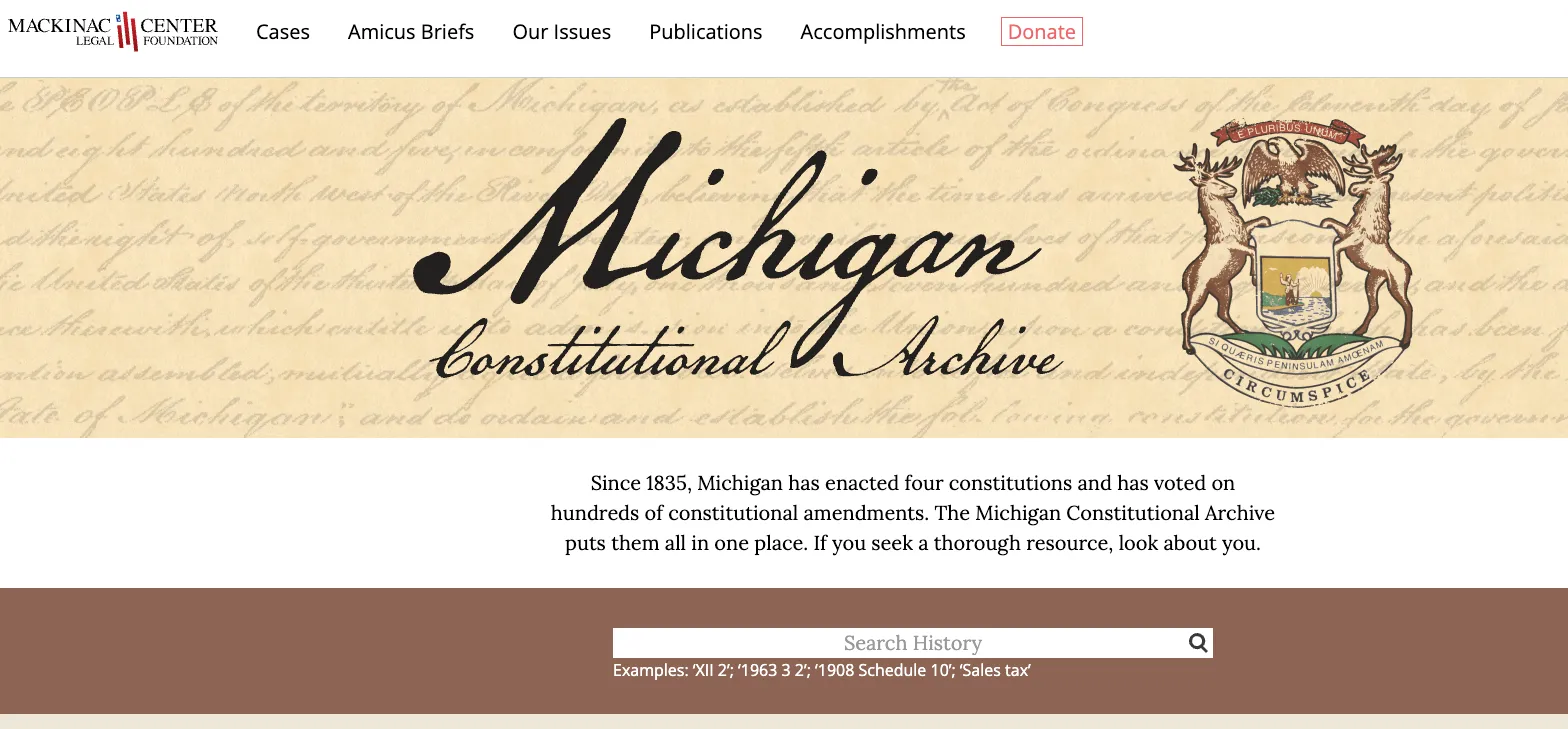
The Michigan Constitutional History Database — officially called the Michigan Constitutional Archive — launched in November 2025. It’s the first resource of its kind in the state. Before it existed, anyone researching Michigan’s constitutional development had to dig through scattered archives, law library collections, and incomplete digital records. Now, everything sits in one searchable platform, freely accessible to the public.
This isn’t just a convenience upgrade for legal scholars. It’s a meaningful shift in how civic history becomes accessible — to lawyers, students, journalists, policy researchers, and engaged citizens alike.
What Is the Michigan Constitutional History Database?
The Michigan Constitutional Archive is a free, publicly accessible online database built and maintained by the Mackinac Center Legal Foundation. Patrick J. Wright, vice president for legal affairs at the Mackinac Center, spearheaded the project.
Since 1835, Michigan has enacted four constitutions and voted on hundreds of constitutional amendments. The archive puts them all in one place.
The database covers every proposed amendment since Michigan’s first constitution in 1835 — all 284 of them. It includes the full text of adopted amendments, the struck-through language of rejected ones, primary source documents, and the complete transcripts of the 1961-62 Constitutional Convention debates.
That last element deserves attention. The convention debates run to thousands of pages. They capture the exact reasoning behind every provision debated during the drafting of Michigan’s current 1963 constitution. No comparable resource has ever organized this material for public search — until now.
Why the Michigan Constitutional History Database Matters
Constitutional databases aren’t glamorous. But they solve a real problem.
Michigan’s constitution has been amended and revised across four separate documents — 1835, 1850, 1908, and 1963. Most provisions carried forward across constitutions were renumbered at each convention. A clause from the 1908 constitution might appear in a completely different article and section number in the 1963 version. Without a tool that traces those connections, understanding the origin of any given provision requires serious archival work.
The Michigan Constitutional Archive solves this with a visual timeline for each provision. Users can trace how a specific clause evolved across conventions — what language existed before, what changed, and what the delegates actually said about it during debates.
For legal practitioners, this is practical gold. Constitutional text alone rarely tells you why a provision exists. The 1961-62 convention debates do.
Inside the Michigan Constitutional History Database: Interface and Features
The search interface is straightforward. Users can search by article and section number, by year and provision, or by plain-language keyword. The database supports multiple search formats. Examples include: ‘XII 2’; ‘1963 3 2’; ‘1908 Schedule 10’; or simply ‘Sales tax’.
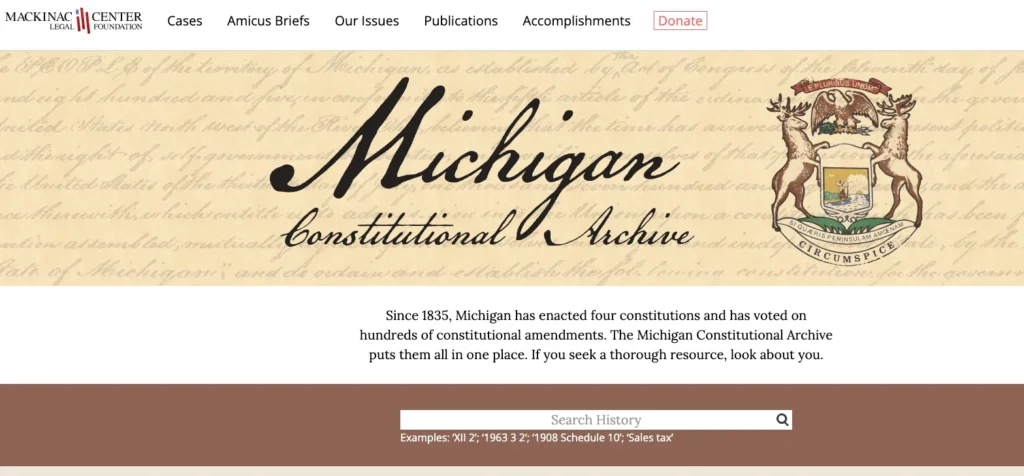
That flexibility matters. A constitutional lawyer might search by exact citation. A journalist or student might search by topic. The database handles both without requiring specialized knowledge of Michigan’s constitutional numbering system.
Search results display the following data for each provision:
- Approved text — the final adopted language
- Strikeout — deleted or rejected language shown in context
- Proposed text — the original language as submitted
- Description — editorial context explaining the provision
- Sources — primary source citations and links
Each record also includes a visual timeline showing the provision’s lineage across Michigan’s four constitutions. This lets researchers see at a glance whether a clause is new to the 1963 document or traces back to 1835.
The archive also organizes content by article. The 1963 constitution’s twelve articles — covering everything from the Declaration of Rights to Finance and Taxation — are all browsable individually. Removed and rejected provisions get their own section, which is particularly useful for understanding what Michigan’s constitutional conventions considered but ultimately left out.
Who Uses This Database, and for What Purpose?
The Michigan Constitutional Archive serves a wide range of users, and the data fields reflect that breadth.
Attorneys and legal researchers are the most obvious audience. Constitutional litigation often turns on original intent — what did the drafters mean? The 1961-62 convention debate transcripts answer that question directly. A lawyer arguing a constitutional case in Michigan now has searchable access to the exact deliberations behind the provision at issue.
Judges and clerks benefit from the same material. Originalist analysis requires primary sources. The archive delivers them in a format that’s actually usable during case research.
Policy researchers and think tank analysts can use the database to trace how Michigan’s constitutional framework has shaped specific policy areas over time. The Finance and Taxation article, for instance, carries the history of Michigan’s revenue-sharing structures and tax limitations — context that’s essential for anyone analyzing current fiscal policy.
Journalists and civic educators gain access to a resource that was previously buried in law libraries. A reporter covering a ballot proposal that touches constitutional language can now quickly check the historical record. A civics teacher can show students the actual text of rejected amendments and the debates behind them.
Students and academic researchers at Michigan law schools and universities get a primary source archive that previously required significant library access to assemble.
For anyone working with legal databases and public records research, the Michigan Constitutional Archive sets a high bar for what state-level constitutional transparency can look like.
How It Compares to Other Legal Databases
No direct competitor exists at the state level. That’s the point — the archive’s press release describes it as “the first database of its kind” in Michigan, and nothing in the existing landscape contradicts that claim.
Westlaw and LexisNexis include Michigan constitutional text. But they don’t offer the convention debate transcripts in searchable form, the visual provision timelines, or the rejected amendment records with strikethrough language. They also cost money — significant money for comprehensive access.
The Michigan Legislature’s website publishes the current constitution but offers no historical depth. The State Archives of Michigan holds relevant primary documents, but they aren’t consolidated or searchable in the way the archive makes them.
What the Michigan Constitutional History Database provides is a combination no existing resource matches: full historical text, primary source debates, visual lineage tracking, rejected provisions, and free public access — all in one searchable interface.
Researchers familiar with Michigan public records databases will recognize a similar philosophy here — open access, consolidated data, and genuine usefulness for both professionals and members of the public.
The Transparency Value This Database Represents
“Michigan’s constitutional history is foundational to understanding how our state’s laws, rights, and government originated and remain relevant,” said Patrick J. Wright, the project’s lead. “The Michigan Constitutional Archive brings transparency and accessibility to that history in one place for the first time.”
That framing — transparency — is the right lens for understanding what this resource actually does. Constitutional documents are public by definition. But public availability and genuine public access are two different things.
When convention debate transcripts sit in physical archives that most people can’t easily visit, they’re technically public but practically inaccessible. When rejected amendments exist only in scattered historical records, they’re part of the constitutional record that nobody reads. The archive changes both of those realities.
This matters especially in a moment when constitutional ballot proposals are increasingly common in Michigan. Voters who want to understand what a proposed amendment actually changes — and how similar language has fared in the past — now have the tools to find out.
Limitations and Data Gaps Worth Knowing
Any honest assessment of this resource has to acknowledge its constraints.
It covers Michigan only. Researchers working on comparative constitutional law across states won’t find material from other jurisdictions here. The archive is deliberately scoped to Michigan’s constitutional history, which makes it deep but not broad.
Editorial context is subjective. Each provision includes a “description” field with editorial context. The Mackinac Center is a free-market, limited-government policy organization. While the archive itself is a factual compilation of primary documents, the editorial framing of individual provisions may reflect institutional perspectives. Users should read description fields as context, not as neutral analysis.
The 1835 and 1850 constitutions receive less depth. The archive’s most detailed material centers on the 1908 and 1963 constitutions and the 1961-62 convention. Documentation from Michigan’s earliest constitutional period is thinner, reflecting the historical record that exists rather than any editorial choice.
Search requires some familiarity with constitutional citation formats. While keyword search works well, users who don’t know that “Article XII, Section 2” relates to the amendment process may struggle to find specific provisions without browsing first. A topic index or guided search feature would improve accessibility for general users.
Real-World Use Cases
The database’s value becomes clearest in specific scenarios.
A Michigan attorney litigating a case involving public employee rights can search Article XI, find the relevant provision, read the approved and proposed text, and then pull the 1961-62 debate transcript to understand exactly what the convention delegates intended. That’s research that previously took days. The archive makes it possible in minutes.
A journalist covering a ballot proposal to change Michigan’s redistricting process can search “redistricting” or navigate to Article IV (Legislative Branch), find every historical amendment that touched the topic, and see which proposals voters rejected and why. That historical context transforms coverage.
A law professor teaching Michigan constitutional law can build a syllabus around primary sources — the actual debate transcripts, the rejected provisions, the visual timelines — instead of relying on secondary summaries. The archive makes primary source teaching practical in a way it wasn’t before.
The Bigger Picture: Public Access to Constitutional History
The Michigan Constitutional Archive fits a broader trend in civic data infrastructure. Governments and research institutions are increasingly digitizing and consolidating primary source records that were previously scattered or inaccessible.
What makes this archive notable is the depth of what it consolidates. Convention debate transcripts are among the most useful — and most underused — primary sources in American legal research. Making them searchable and free changes who can use them.
The Mackinac Center built this as an educational resource, and that intent shows in the design. The interface doesn’t require a law degree to navigate. The search examples on the homepage — including plain-language terms like “Sales tax” — signal that the archive aims to serve curious citizens, not just trained researchers.
That’s the right ambition for a constitutional archive. Michigan’s constitution belongs to Michigan’s residents. A database that makes it genuinely accessible — not just technically available — serves the public interest in a meaningful way.
The Michigan Constitutional Archive is free and publicly accessible. For anyone researching Michigan law, policy, or civic history, it’s now the essential starting point.
Sources
- Michigan Constitutional Archive – Mackinac Center Legal Foundation
- Mackinac Center Launches First Comprehensive Database of Michigan’s Constitutional History
This article was created with AI assistance and reviewed by a human editor.

