


Most cybersecurity databases focus on vulnerabilities that have already been discovered. The OpenCryptography Database takes a different approach. Instead of asking whether a piece of software has a known flaw, it asks a broader and increasingly important question: What cryptography is actually being used inside modern software, and could it become a future security risk?
Launched by SandboxAQ, the OpenCryptography Database is a public platform designed to expose cryptographic implementations across open-source software. At a time when organizations are preparing for post-quantum cryptography and facing growing software supply chain risks, the database offers something that many security teams have historically lacked: visibility.
For readers interested in exploring other public research tools, our Free and Open Databases Directory also collects useful public databases across government, science, business, law, and cybersecurity-related fields.
Unlike traditional security resources that primarily focus on disclosed vulnerabilities, OpenCryptography aims to reveal the cryptographic foundations hidden beneath software dependencies. That distinction may become increasingly important as organizations attempt to understand not only whether software is vulnerable today, but whether its cryptographic architecture could become a problem tomorrow.
What Is the OpenCryptography Database?
The OpenCryptography Database is a publicly accessible resource that analyzes open-source software and container images to identify cryptographic components, algorithms, certificates, keys, and related security issues.
According to the platform’s official documentation, the project was created to help organizations better understand their cryptographic exposure and prepare for future security challenges. The database is powered by cryptographic discovery and analysis technology developed by SandboxAQ and is intended to make cryptographic risk more transparent across the software ecosystem.
The platform was officially introduced by SandboxAQ in a September 2025 press release, where the company described it as the first public database focused specifically on exposing cryptographic risks across open-source software ecosystems.
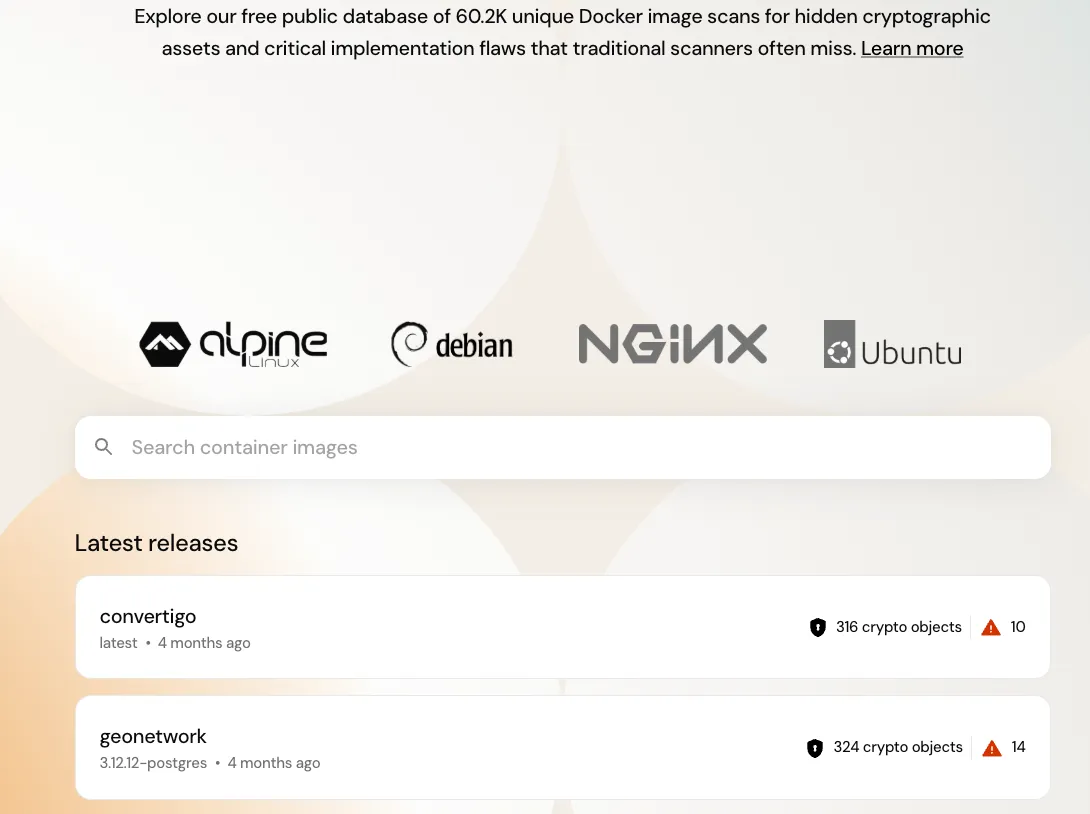
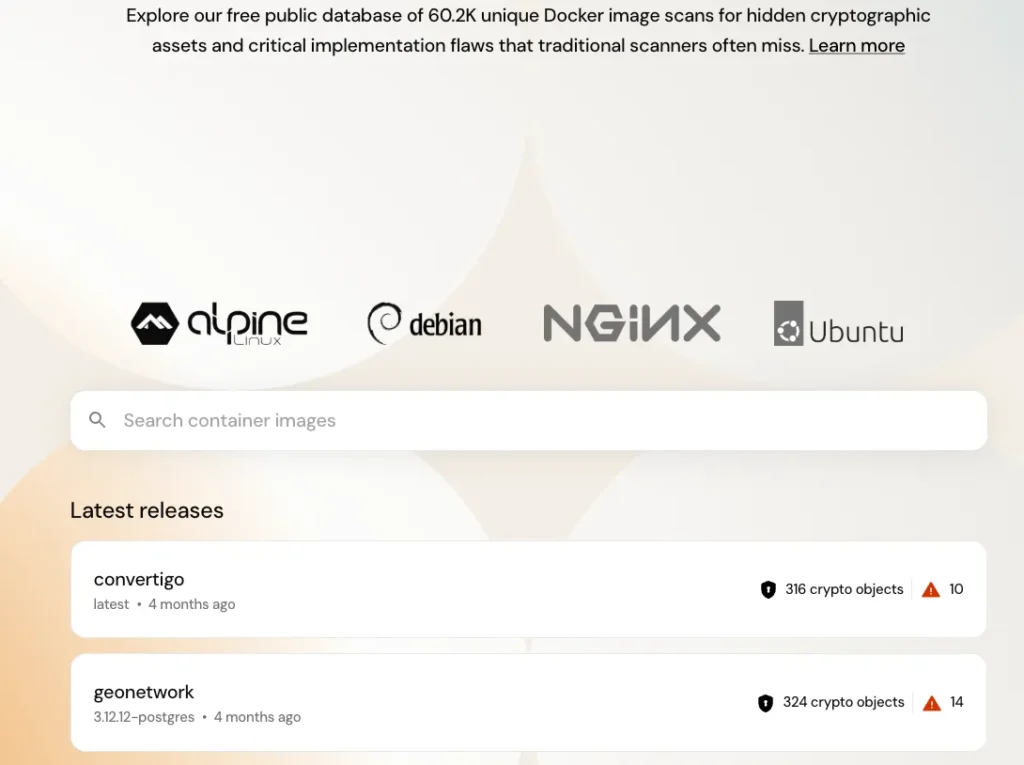
One noteworthy aspect of the platform is its simplicity. The homepage centers around a search bar where users can quickly investigate specific container images. Rather than navigating complex dashboards, users can begin exploring cryptographic findings almost immediately.
Why Cryptographic Visibility Matters
Security teams have traditionally relied on resources such as the CVE Database to identify publicly disclosed software flaws and prioritize remediation efforts. These databases remain essential, but they only tell part of the story.
Not every security issue receives a CVE identifier.
A software package may contain:
- Deprecated cryptographic algorithms
- Weak key sizes
- Problematic certificate configurations
- Cryptographic libraries approaching end-of-life
- Implementations that could become vulnerable in a post-quantum world
These issues may never appear in a traditional vulnerability database, yet they can still create meaningful long-term risk.
Similarly, the European Vulnerability Database improves visibility into software vulnerabilities across Europe, but OpenCryptography focuses on a different challenge: understanding the cryptographic infrastructure embedded within software itself.
This distinction is what makes the platform particularly interesting. Vulnerability databases help security teams identify known flaws. OpenCryptography helps users investigate the cryptographic components that may create future risks even when no vulnerability has been publicly disclosed.
A Closer Look at the User Experience
After testing the public interface, one of the platform’s strengths becomes immediately apparent: it presents technical findings in a relatively accessible format.
When searching for a container image, users can access information including:
- Release Date
- Scanned Date
- View by Application
- View by Issues
- Show Only Material Risks
The Show Only Material Risks option is particularly valuable.
Many security tools generate overwhelming volumes of findings. In practice, security teams often spend significant time separating genuine concerns from issues that are technically noteworthy but operationally insignificant.
OpenCryptography attempts to address that challenge by highlighting risks that remain materially relevant after additional analysis.
In my view, this is one of the platform’s strongest features. Security professionals are not struggling to find more alerts; they are struggling to determine which alerts actually matter.
What Information Can You Find in the OpenCryptography Database?
The database provides more than a simple list of cryptographic findings.
Pull up any result and you will see a handful of metrics that are more useful than they look at first glance:
- Crypto Objects Discovered
- Objects with Critical or High Severity Issues
- Material Risk Assessments
- Application-Level Findings
- Issue-Level Findings
One particularly useful feature is the enrichment layer applied to findings.
For example, a result may indicate:
4 of those issues were found not to carry material risk after our data enrichment process. 0 were found to still carry material risk.
This context matters.
Traditional security scanners frequently produce large numbers of alerts that require manual investigation. By attempting to distinguish theoretical issues from material risks, OpenCryptography offers a more practical perspective on cryptographic exposure.
While users should still perform their own validation, the additional context helps reduce noise and improve prioritization.
How OpenCryptography Differs From Traditional Security Databases
The easiest way to understand OpenCryptography is to compare it with traditional security databases.
A conventional vulnerability database answers questions such as:
- Does this software contain a known vulnerability?
- Has a flaw been assigned a CVE?
- Is a patch available?
OpenCryptography answers different questions:
- Which cryptographic algorithms are present?
- Which certificates and keys are in use?
- Are cryptographic best practices being followed?
- Could future cryptographic weaknesses emerge?
- Does this software contain cryptographic components that warrant review?
Rather than replacing vulnerability databases, OpenCryptography complements them.
Organizations that already rely on vulnerability intelligence can use OpenCryptography as an additional layer of cryptographic transparency.
Why the OpenCryptography Database Matters for Post-Quantum Security
One of the strongest arguments for the OpenCryptography Database is its relevance to post-quantum security planning.
Organizations around the world are preparing for a future in which certain cryptographic algorithms may no longer provide adequate protection against sufficiently powerful quantum computers.
The NIST Post-Quantum Cryptography Program has spent years developing new cryptographic standards designed to address this challenge.
However, organizations face a practical problem before any migration can occur:
They first need to understand where cryptography currently exists.
Without visibility into algorithms, certificates, libraries, and dependencies, planning a transition becomes extremely difficult.
OpenCryptography helps bridge that visibility gap by making cryptographic inventory information more accessible.
Who Can Benefit From the OpenCryptography Database?
The obvious users are security teams and developers — but the platform is actually useful to a broader group than it might first appear.
Security Teams
Security professionals can use the database to support cryptographic audits, software reviews, and risk assessments.
Developers
Developers gain visibility into cryptographic dependencies embedded within applications and container images.
Compliance Teams
Organizations following CISA software supply chain security guidance may find cryptographic inventory data increasingly valuable as regulatory expectations evolve.
Open-Source Maintainers
Maintainers can identify cryptographic components that may require modernization or replacement.
Researchers and Journalists
The database provides a useful resource for investigating software security trends and understanding cryptographic adoption across open-source ecosystems.
OpenCryptography Database Limitations Worth Considering
Although OpenCryptography offers an innovative approach, it is not without limitations.
First, coverage will inevitably be incomplete. No public database can analyze every repository, package, or container image in existence.
Second, cryptographic findings require context. The presence of a specific algorithm does not automatically indicate a security problem. Security decisions should not be made solely on the basis of automated findings.
Third, the platform remains relatively new. Long-term adoption will depend on:
- Data quality
- Update frequency
- Coverage breadth
- Methodology transparency
These are common challenges for any emerging cybersecurity database.
Final Assessment
The OpenCryptography Database represents one of the more interesting cybersecurity database launches in recent years.
Its value lies not in replacing established resources such as the CVE Database or the European Vulnerability Database, but in exposing an area of software risk that often remains invisible: cryptographic infrastructure.
OpenCryptography also reflects a broader trend toward transparency-focused public databases. Similar initiatives can be found in areas such as vulnerability tracking, regulatory disclosure systems, and public safety data. For example, our review of the FDA Complete Response Letter Database examined how newly available data can improve visibility into regulatory decision-making. OpenCryptography applies a similar transparency model to cryptographic risk within software supply chains.
After exploring the platform, the search-driven interface, application-level views, issue-level views, release and scan dates, and material-risk filtering stand out as practical features rather than marketing promises. The database appears designed to help users investigate cryptographic exposure quickly without requiring extensive expertise in cryptography itself.
Whether OpenCryptography ultimately becomes a widely adopted industry resource remains to be seen. However, its focus on transparency, cryptographic inventory, and post-quantum readiness addresses a real problem facing modern software ecosystems.
Software supply chains were already complicated before quantum computing entered the conversation. Adding cryptographic inventory to the mix is not optional anymore — it is just a question of when organizations take it seriously.
This article was created with AI assistance and reviewed by a human editor.

