


Most people outside the film business probably assume that actors, directors, and producers get discovered through glamorous premieres, viral interviews, or red-carpet exposure.
In reality, a surprising amount of the international film industry still runs on databases, spreadsheets, festival catalogs, and private professional networks.
That is partly why the EFP Talent Database is more interesting than it first appears.
At face value, the platform looks fairly simple. It does not have the polished feel of a modern streaming service or the aggressive networking design of LinkedIn-style talent marketplaces. But after spending time with the database itself, it becomes obvious that it was built for a very specific purpose: helping film industry professionals quickly identify emerging European talent across a fragmented international landscape.
And in fairness, it does that reasonably well.
The database is operated by European Film Promotion (EFP), an organization focused on increasing the international visibility of European cinema. In many ways, the platform functions like a digital extension of Europe’s festival ecosystem — quietly connecting actors, producers, directors, and industry professionals long after festival premieres and networking events end.
It also reflects a broader trend visible across many specialized industry databases: industries increasingly rely on curated digital infrastructures to organize professional visibility, talent pipelines, and institutional networks.
The EFP Talent Database Feels Designed for Actual Industry Use
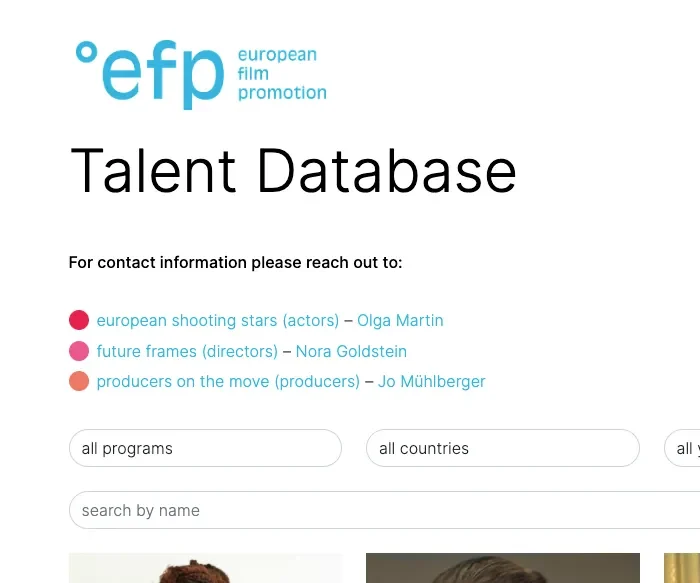
One of the first things that stands out while using the EFP Talent Database is how straightforward the search system is.
Users can browse profiles by:
- programs
- countries
- years
- gender
That may sound basic, but in practice it makes the platform surprisingly efficient.
A lot of entertainment industry platforms try to overwhelm users with social features, recommendation systems, or endless profile layers. The EFP database takes a much more restrained approach. The filtering tools are simple, visible, and functional.
During busy festival periods or co-production markets, that matters.
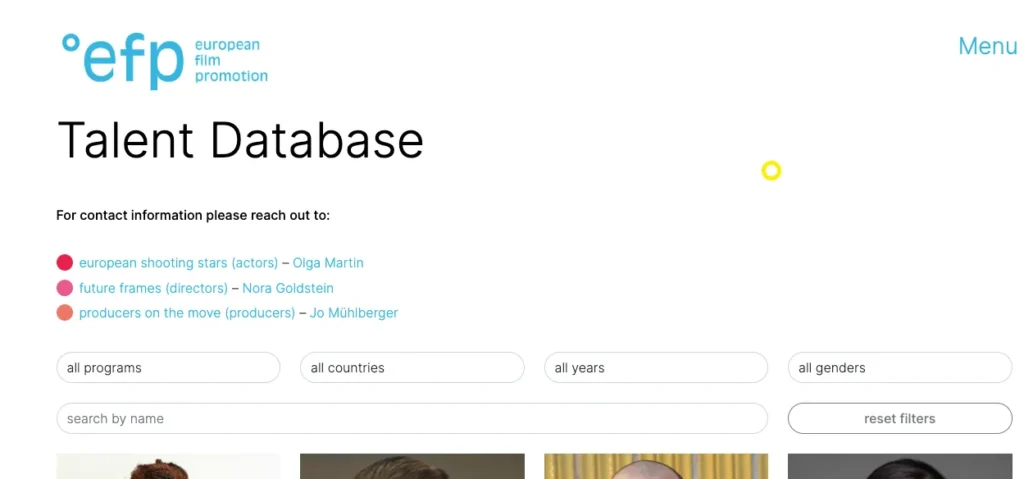
A producer searching for emerging directors from a particular region or a journalist researching former European Shooting Stars participants can move through the database quickly without dealing with cluttered interfaces or unnecessary distractions.
The inclusion of profile images also helps considerably. In creative industries, visual recognition matters more than many database designers acknowledge. Seeing actors, directors, and producers directly attached to profiles makes the platform feel more connected to the real film industry rather than just a static institutional archive.
Interestingly, the interface itself feels slightly old-fashioned by modern startup standards — but not necessarily in a bad way.
There is very little sense that the platform is trying to maximize engagement or keep users endlessly scrolling. It behaves more like a professional working tool than a social platform. After using it for a while, that restraint actually becomes refreshing.
What Is the EFP Talent Database?
The EFP Talent Database is a searchable online directory connected to European Film Promotion’s talent initiatives and international networking programs.
The platform primarily includes professionals associated with initiatives such as:
- European Shooting Stars
- Producers on the Move
- Future Frames
Rather than operating as an open public talent marketplace, the database focuses on curated professional visibility. Most individuals included in the system have already participated in EFP-backed programs or industry development initiatives.
That distinction matters because it changes the database’s role entirely.
This is not a platform where anyone uploads a profile hoping to become discoverable. The database functions more like a professional industry registry tied to institutional recognition and festival-linked talent development.
For film professionals, that gives the platform a different type of credibility.
Europe’s Film Industry Still Has a Visibility Problem
The deeper reason the database exists comes down to one issue: Europe’s film industry remains structurally fragmented.
Hollywood benefits from concentration. Europe largely does not.
Funding systems differ country by country. Distribution networks vary dramatically. Language barriers still shape audience reach. A filmmaker can become successful in Poland, Denmark, or Portugal while remaining almost invisible outside their domestic market.
That fragmentation creates long-term discoverability problems.
And today, those problems matter more than they once did.
Streaming platforms are investing aggressively in international productions. European content now travels globally in ways that would have been difficult to imagine fifteen years ago. Shows like Dark, Money Heist, and Babylon Berlin helped normalize subtitled productions for mainstream audiences.
As a result, producers, distributors, casting professionals, and festival programmers increasingly search Europe for emerging talent with international potential.
The EFP Talent Database attempts to make that search process more structured.
European Shooting Stars Still Carries Serious Industry Recognition
Among EFP’s initiatives, European Shooting Stars is probably the best known internationally.
The program introduces selected European actors to the global industry during the Berlin International Film Festival. Within European cinema circles, participation still carries noticeable prestige.
And after exploring the database itself, it becomes easier to understand why maintaining these profiles matters.
Festival attention is temporary. Careers are not.
An actor may receive substantial industry buzz during Berlinale and then quickly disappear from international conversations once the festival cycle ends. The database helps preserve visibility beyond that short promotional window.
For casting directors, journalists, or distributors researching talent years later, that continuity becomes genuinely useful.
One thing the platform does fairly well is preserving professional context. Instead of feeling like disconnected festival archives, the profiles create a sense of long-term career tracking across multiple years and initiatives.
Producers on the Move Shows How European Cinema Actually Operates
The Producers on the Move section may be less publicly recognizable than European Shooting Stars, but from an industry perspective it is arguably just as important.
European productions often depend on highly complex financing structures involving:
- public film institutes
- regional funding systems
- co-production agreements
- broadcasters
- private investment
- international sales partnerships
Because of that, producers frequently become the people connecting entire cross-border projects together.
The database indirectly reveals how international European cinema really functions behind the scenes.
A producer in Belgium may need funding support from Germany, distribution relationships in France, and festival exposure in Italy simultaneously. Networking is not optional in that environment — it is infrastructure.
That is one reason centralized visibility systems matter so much inside the European film ecosystem.
Future Frames and the Industry’s Push Toward Early Talent Discovery
The Future Frames initiative focuses on young directors and film school graduates considered to have strong international potential.
And honestly, this section of the database says a lot about where the industry is heading.
Streaming platforms and production companies increasingly scout talent earlier than ever before. Emerging filmmaker programs, short film competitions, and film school showcases now function almost like early-stage recruitment systems for the international content industry.
The database reflects that shift clearly.
After browsing several profiles, the platform feels less like a traditional archive and more like an evolving map of Europe’s next generation of filmmakers.
Some profiles are naturally more detailed than others, and certain regions appear more represented than others. But the broader idea is still significant: the industry increasingly wants structured systems for identifying creative talent before careers fully mature.
Who Actually Uses the EFP Talent Database?
The platform is clearly not aimed at casual movie fans.
In practical terms, the database is most useful for:
- producers searching for collaborators
- festival programmers scouting emerging filmmakers
- casting directors monitoring rising acting talent
- distributors and sales agents tracking European cinema trends
- journalists researching career development
- streaming companies exploring new creative voices
After spending time with the platform, it becomes obvious that efficiency matters more here than aesthetics.
The database is built for professionals trying to identify people quickly, not for audiences casually browsing celebrity content.
The Platform’s Biggest Strength Is Also Its Biggest Limitation
The EFP Talent Database benefits enormously from being curated.
Because profiles are connected to recognized industry initiatives, the platform carries a degree of institutional credibility that many open-registration talent websites simply lack.
At the same time, that curation inevitably creates gatekeeping.
Talented filmmakers outside major festival networks may remain invisible. Smaller national industries can struggle for representation. Certain professional circles naturally receive more exposure than others.
The database does not create those inequalities on its own — the broader film industry already operates that way — but it does reflect them.
And that tension is probably impossible to separate from modern creative industries altogether.
Data Quality, Maintenance, and Transparency
Like most professional databases, the EFP platform also faces practical maintenance challenges.
Film careers evolve quickly. Representation changes. New productions appear constantly. Some profiles inevitably feel more complete or updated than others.
That does not make the platform unreliable, but it does shape how useful it is in practice.
The database works best as:
- a discovery tool
- a professional reference system
- an industry networking resource
- a visibility archive tied to European film initiatives
rather than a fully real-time industry tracker.
One thing that helps is the platform’s overall simplicity. Because the database avoids excessive features and social-style interaction systems, navigating information remains relatively easy even when profile depth varies.
Final Thoughts
The EFP Talent Database is not trying to compete with mainstream entertainment platforms or social networking tools.
Its purpose is narrower — and probably more valuable because of that.
After exploring the database directly, the platform feels less like a startup product and more like a piece of quiet industry infrastructure built around a specific problem: European film talent often becomes difficult to track across fragmented national markets and short-lived festival cycles.
The database does not solve that problem entirely. No single platform could.
But by connecting initiatives like European Shooting Stars, Producers on the Move, and Future Frames into a centralized searchable system, EFP has created a genuinely useful professional resource for parts of the international film industry.
And as streaming platforms continue investing in international productions, systems like this will likely become even more important — not only for discoverability, but for determining which creative voices remain visible in the global film conversation.
Sources
- European Film Promotion – Talent Database
https://efp-online.com/talent-database - European Film Promotion – What We Do
https://efp-online.com/whatwedo

