


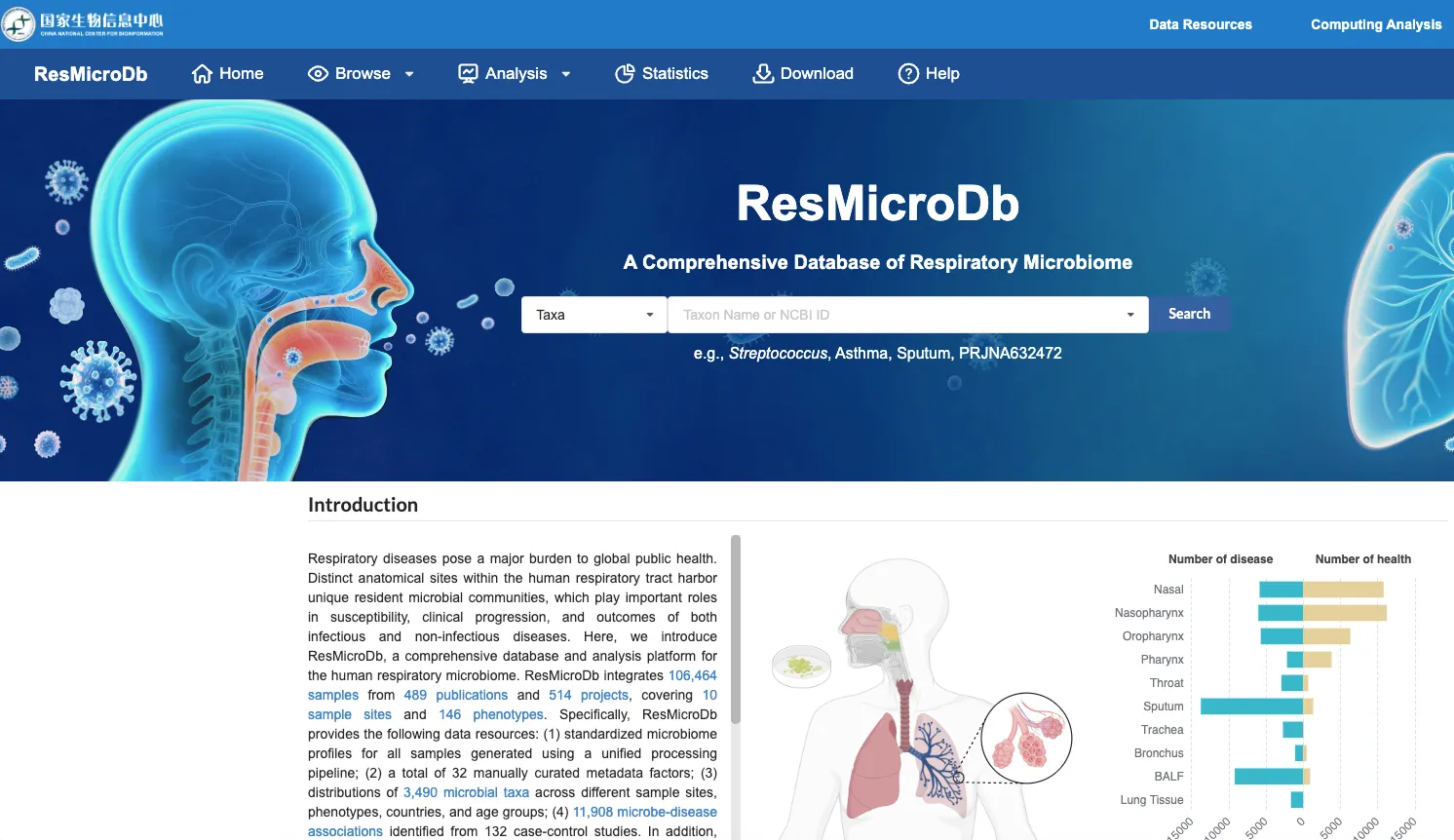
In June 2025, researchers at the China National Center for Bioinformation launched the ResMicroDb database. Most of the scientific community had not yet noticed. However, what they built is genuinely hard to ignore. The platform gives free access to over 106,000 human respiratory microbiome samples. Moreover, it draws from 514 research projects and 489 peer-reviewed publications. For anyone working in pulmonology, infectious disease, or microbiome research, this resource reframes what public data can actually do.
The respiratory microbiome is the collection of bacteria, fungi, and viruses living in our airways. For years, it remained one of the most underexplored frontiers in human biology. The problem was not a lack of interest. Instead, researchers faced fragmented data, inconsistent labeling, and results that were nearly impossible to compare across studies. ResMicroDb was built precisely to solve that.
Why the Respiratory Microbiome Matters More Than Most People Realize
For decades, scientists considered the lower respiratory tract sterile. That assumption turned out to be wrong. Advances in metagenomic sequencing revealed something unexpected. The lungs, bronchi, and surrounding tissues host distinct microbial communities. Furthermore, these communities actively regulate immune responses, influence inflammation, and either resist or enable pathogen colonization.
The stakes are significant. According to the research behind ResMicroDb, COPD and lower respiratory infections rank among the top five causes of death globally. Together, they accounted for roughly 6 million deaths in 2021. In addition, asthma, pneumonia, cystic fibrosis, and COVID-19 all have documented links to respiratory microbiome disruption â what researchers call dysbiosis.
A Concrete Clinical Example
Consider COVID-19 patients. A higher abundance of Streptococcus parasanguinis at hospital admission correlated with better prognosis. This finding suggests that microbial patterns may carry real clinical predictive value. However, until now, no single large-scale repository existed to explore these patterns systematically.
Researchers had to piece together data from general multi-body-site databases. Many of those databases labeled respiratory samples vaguely â often just “upper respiratory tract.” They rarely specified whether a sample came from the nasopharynx, the oropharynx, or the trachea. That distinction matters enormously for both research accuracy and clinical interpretation.
What the ResMicroDb Database Actually Contains
Scale is ResMicroDb’s most immediate differentiator. The database integrates 106,464 samples across 10 distinct sample sites, 72 sample types, and 146 phenotypes. For context, the closest comparable resource â mBodyMap â contains roughly 12,500 respiratory samples. Therefore, ResMicroDb holds approximately seven times more data.
Those samples break down across three sequencing methodologies:
- 90,338 samples from 16S rRNA amplicon sequencing
- 12,799 samples from metagenomic sequencing
- 3,327 samples from metatranscriptomic sequencing
Manually Curated Metadata
Each sample carries up to 32 manually curated metadata fields. These include sample site, sample type, sequencing platform, phenotype, age, sex, BMI, smoking status, antibiotic use, country, and continent. Crucially, researchers curated this data by hand â not algorithmically. That effort separates ResMicroDb from repositories that simply aggregate raw data and leave researchers to sort it out themselves.
The most represented sample sites are the nasopharynx (23.2%), nasal tissue (16.7%), sputum (16.4%), oropharynx (12.9%), and bronchoalveolar lavage fluid at 11.8%. Samples come from 54 countries. The United States contributes the largest share at nearly 22%, followed by China (15.4%) and the Netherlands (12.2%).
Beyond raw samples, ResMicroDb also provides 11,908 microbe-disease associations. Researchers identified these through 132 case-control studies. Importantly, these are not text-mined estimates. Instead, they come from standardized differential abundance analysis using methods like MaAsLin2, ALDEx2, and ZicoSeq.
How to Search the ResMicroDb Database
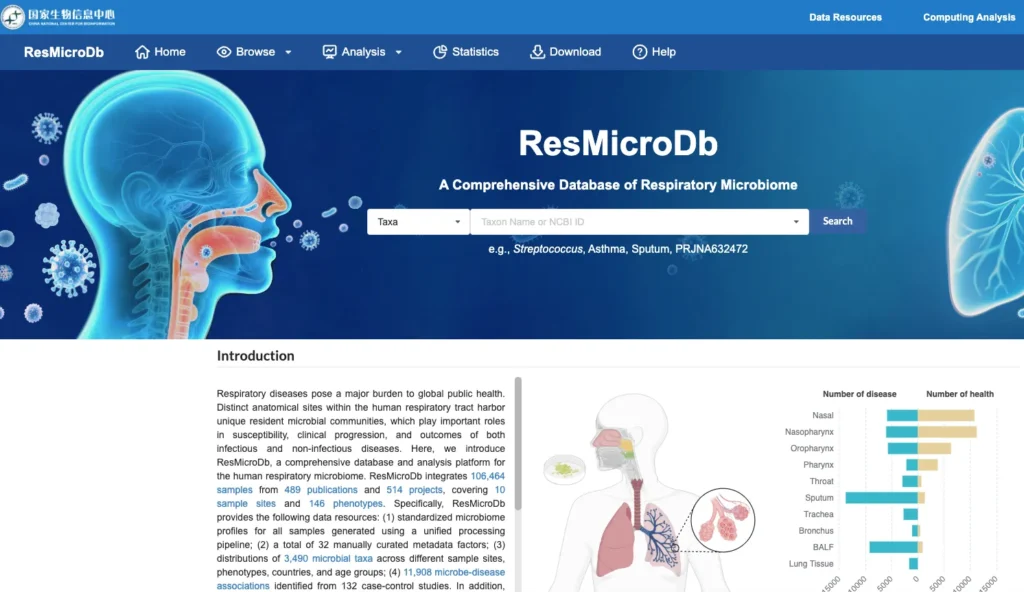
The search interface is one of the platform’s most practically useful features. The homepage offers a central search bar with four modes: Taxa, Phenotype, Sample Site, and Project. Each targets a different entry point, depending on what a researcher needs.
The Taxa Search in Practice
The Taxa search is particularly well-designed. You can enter a taxon name or an NCBI Taxonomy ID. For example, the platform accepts inputs like Streptococcus, Asthma, Sputum, or a BioProject identifier such as PRJNA632472. As you type, a dropdown autocomplete list appears in real time. It populates with matching entries from the database. Clicking any result brings up a detailed taxon page. That page includes:
- Introduction â taxonomic lineage, NCBI Taxonomy ID, and a biological description
- Distribution across sample sites â prevalence and abundance broken down by anatomy, phenotype, country, and age group
- Marker taxon analysis â where this microbe appears as a statistically significant biomarker across case-control studies
- Links to related resources â including NCBI taxonomy entries and associated publications
Take Streptococcus as a working example. Searching for it reveals that this genus appears in over 90% of samples across nine of ten respiratory sites. At the oropharyngeal level, its abundance peaks in the first three years of life. Moreover, it varies significantly by country â higher in Canadian and UK samples than in others. In COVID-19 patients, furthermore, three independent studies from China and Jordan all found significantly lower Streptococcus abundance in throat swabs compared to healthy controls.
That kind of cross-study corroboration â visible in a single interface â saves researchers weeks of manual literature review.
Three Built-In ResMicroDb Database Analysis Tools Worth Knowing
Beyond data browsing, ResMicroDb includes three active analysis modules. Together, these tools distinguish it clearly from a simple data repository.
Microbiome Composition
This tool generates taxonomic profiles for any user-defined combination of sample site, phenotype, and sequencing strategy. For example, select “Oropharynx,” filter for “COVID-19,” and choose “16S amplicon.” As a result, the tool returns a heatmap of the top 15 genera and a pie chart summarizing average community composition. For COVID-19 oropharyngeal samples specifically, the dominant genera are Prevotella, Streptococcus, Staphylococcus, Veillonella, and Neisseria. This is consistent with published findings in the literature.
Sample Similarity Search
This is the most technically novel feature in the database. Users upload their own microbiome sample â a taxonomic abundance profile â and the system finds the most similar existing samples. The tool compares using Bray-Curtis distance, Jaccard distance, or Jensen-Shannon divergence. It then returns similarity scores, matched metadata, and the microbial profiles of the closest database entries.
Think of it as a BLAST search for microbiome profiles. The practical use case is straightforward. A researcher with a newly collected nasopharyngeal sample can query it against 106,000 existing samples. In doing so, they can infer its likely disease context, validate its site classification, or identify comparable published cohorts. Query times run between four and seven seconds for 16S samples â fast enough for routine use.
Cross-Study Analysis
This tool enables meta-analysis across multiple cohorts. Importantly, it does not require users to download and manually merge datasets. Select a sample site and phenotype â for instance, nasal samples from patients with chronic rhinosinusitis. The tool then identifies all relevant case-control cohorts in the database. In this case, it finds eight cohorts spanning multiple countries. Subsequently, it runs unified differential abundance analysis, diversity comparisons, and co-occurrence network construction across all of them.
The output identifies which microbial genera consistently appear enriched or depleted across studies â not just within a single cohort. In the chronic rhinosinusitis example from the published paper, Corynebacterium appeared significantly more abundant in healthy controls across six independent cohorts. Individual studies likely lacked the statistical power to establish that finding on their own.
How the ResMicroDb Database Compares to Other Microbiome Databases
It helps to situate ResMicroDb within the broader landscape of publicly accessible microbiome resources. The main alternatives for respiratory data are:
- mBodyMap â 12,498 respiratory samples, 64 projects, 136 microbe-disease associations, limited site resolution
- HumanMetagenomeDB â 1,336 respiratory samples, metadata only, no analytical tools
- BugSigDB â 338 respiratory-related associations from 68 publications, derived from text mining rather than direct analysis
ResMicroDb outpaces all three on scale, anatomical resolution, and built-in analytical capability. It is the only one of the four that offers Sample Similarity Search and Cross-Study Analysis. Furthermore, it provides standardized taxonomic profiles generated through a single unified bioinformatics pipeline. That consistency makes cross-study comparison genuinely valid â rather than technically tenuous.
Researchers already familiar with platforms like PubChem or the CDC WONDER database will recognize a similar philosophy here. ResMicroDb serves as a centralized, curated, freely accessible platform. It dramatically reduces the friction of working with public data. For a broader look at scientific databases of this caliber, the science databases section at TheDatabaseSearch.com covers similar tools across disciplines.
Data Download and Access
ResMicroDb is fully open access. The download section lets users retrieve taxonomic profile tables, curated metadata, and microbe-disease association data in bulk. Raw sequencing data traces back to three primary archives: NCBI Sequence Read Archive (SRA), the European Nucleotide Archive (ENA), and the China National Center for Bioinformation’s Genome Sequence Archive (GSA). All three are publicly accessible without registration.
ResMicroDb Database: Limitations and Open Questions
ResMicroDb is an impressive technical achievement. However, it has real limitations worth acknowledging â particularly for researchers considering it as a primary data source.
Geographic Bias
Nearly 22% of all samples come from the United States. Another 15% come from China. While 54 countries are represented, the distribution skews heavily toward high-income research settings. This matters because respiratory microbiome composition reflects geography, climate, diet, and antibiotic exposure. Those factors vary enormously between a rural clinic in sub-Saharan Africa and a university hospital in Boston.
Uneven Metadata Coverage
While 32 fields are curated, coverage varies substantially. Sample site is available for 100% of records. However, metadata like BMI, antibiotic use, and disease severity scores are missing for large subsets of the dataset. The research team acknowledges this openly. It reflects how inconsistently original studies reported their data â not a failure of curation.
Snapshot, Not a Live Registry
The database launched in June 2025 and covers literature through January 2025. It is a snapshot, not a continuously updated registry. How frequently it will be refreshed remains unspecified. That gap matters in a field where hundreds of new studies appear each year.
Phenotype Inference Has Real Limits
The Sample Similarity Search tool is genuinely useful. Nevertheless, the platform’s own published paper urges caution. In a validation exercise with four external samples, the tool correctly identified both sample site and phenotype for only two of them. As a result, microbiome-based phenotype inference should be treated as probabilistic â not diagnostic.
Institutional Origin
The database operates at the China National Center for Bioinformation (CNCB), affiliated with the Chinese Academy of Sciences. The underlying data comes from public repositories (NCBI SRA, ENA, GSA). The paper was also peer-reviewed and published in Nucleic Acids Research â one of the most respected journals in the field. There is no indication of data manipulation. Still, researchers in sensitive institutional contexts may want to note the hosting arrangement.
Who Is This ResMicroDb Database For?
ResMicroDb is primarily a research tool. Its most natural users are:
- Microbiome researchers designing new studies who want to understand existing microbial patterns at specific respiratory sites
- Bioinformaticians building predictive models who need large, consistently processed training datasets
- Pulmonologists and infectious disease specialists exploring the microbial context of COPD, cystic fibrosis, asthma, or COVID-19
- Public health scientists examining population-level patterns in respiratory health
- Graduate students and academic researchers conducting literature synthesis or meta-analyses
It is not, at this stage, a clinical decision support tool. The associations it surfaces come from research cohorts. They are not validated for individual patient care. That distinction matters.
The Broader Significance
What makes ResMicroDb meaningful goes beyond its technical specifications. It represents a serious attempt to make publicly funded microbiome research actually reusable. The raw data behind most of the 106,000 samples already existed in public repositories. However, it existed in fragments â different naming conventions, inconsistent metadata, incompatible processing pipelines. Most of it was effectively inaccessible to anyone without significant computational resources and domain expertise.
ResMicroDb did that harmonization work and made the result freely available. That is the kind of infrastructure investment that accelerates an entire field. It does not produce new data. Instead, it makes existing data genuinely usable. For researchers navigating the growing landscape of publicly accessible scientific resources, platforms like this set a meaningful standard for what open data can look like when it is properly curated. The health databases covered at TheDatabaseSearch.com reflect a similar principle: well-organized public data, made genuinely accessible, compounds in value over time.
Whether ResMicroDb becomes a cornerstone of respiratory microbiome research depends partly on update frequency and community adoption. Its launch in mid-2025, backed by a peer-reviewed paper in Nucleic Acids Research, gives it a credible foundation. The scale of what it has already assembled suggests the team behind it takes the long view seriously.
ResMicroDb Database Sources
- Ji X, Qian Q, Zhang H, et al. ResMicroDb: a comprehensive database and analysis platform for the human respiratory microbiome. Nucleic Acids Research. 2025 Dec 3; Volume 54, Issue D1, Pages D858âD870.
- ResMicroDb â Official Database Platform, China National Center for Bioinformation.
- NCBI Sequence Read Archive (SRA), National Center for Biotechnology Information.
- European Nucleotide Archive (ENA), European Bioinformatics Institute.
- Genome Sequence Archive (GSA), China National Center for Bioinformation.
This article was created with AI assistance and reviewed by a human editor.

