


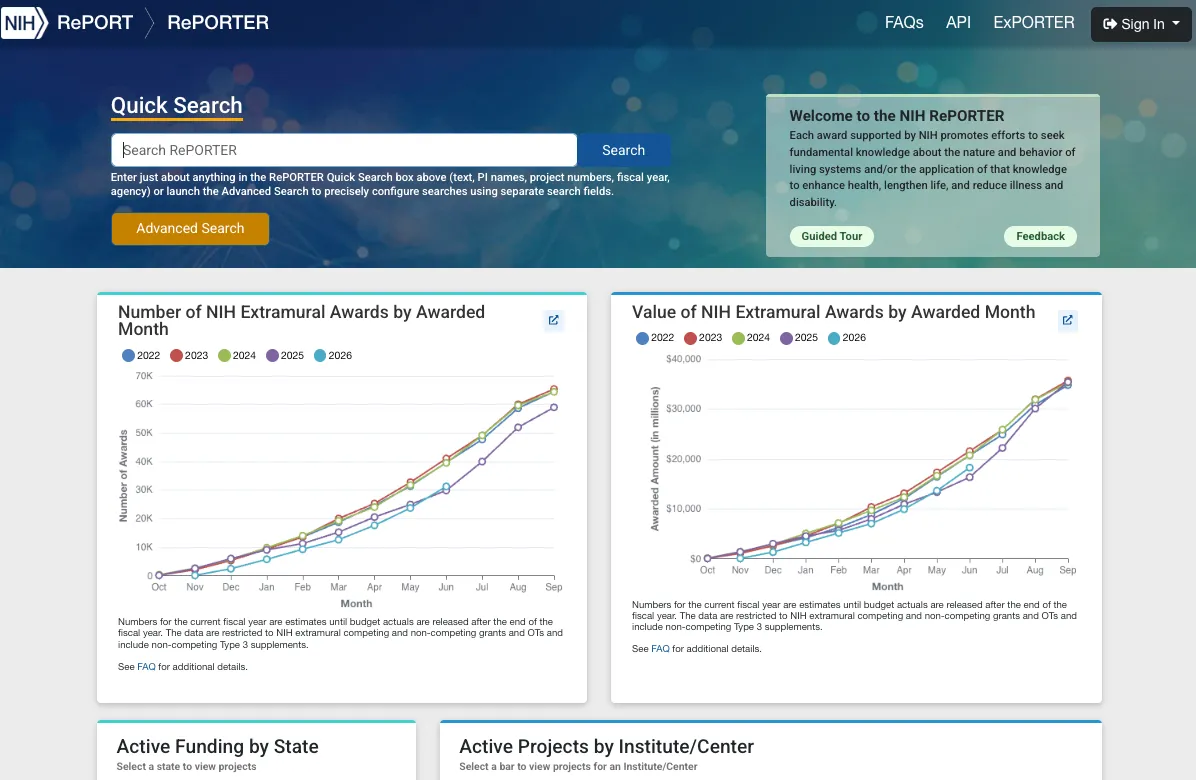
Every year, the National Institutes of Health hands out tens of billions of taxpayer dollars. Scientists use it to study everything from pancreatic cancer to the biology of aging. Most people never see where that money lands. NIH RePORTER is the tool that pulls back the curtain. It is a free, public database. Anyone can use it — a researcher, a journalist, a patient advocate, or a curious taxpayer. It lets you trace a single federal research grant to its core details. That means the investigator, the institution, the dollar amount, and the resulting papers and patents.
That last point is what makes RePORTER unusual. Plenty of government portals tell you that money was spent. Very few connect the dollars to the actual scientific output. Do you want to know not just who got funded, but what came of it? This is one of the most revealing public tools in American science.
What NIH RePORTER Actually Is
RePORTER stands for Research Portfolio Online Reporting Tools Expenditures and Results. It is the flagship search interface inside the broader NIH RePORT family of reporting tools. The NIH maintains it directly.
At its core, RePORTER is a searchable repository of NIH-funded research projects. The database is updated weekly with new extramural project information, according to the official NIH RePORTER site. It draws its data from a mix of internal and public sources. These include the eRA grants databases, MEDLINE and PubMed, PubMed Central, the NIH Intramural Database, and iEdison. The last of these tracks federally funded inventions.
This matters because the NIH is the largest public funder of biomedical research in the world. It distributes roughly $47 billion a year. The overwhelming majority flows outward as competitive grants. These go to universities, hospitals, and research institutes across the country. RePORTER is where that river of funding becomes searchable, line by line.
Why the Database Exists — and Why Transparency Was the Point
RePORTER did not appear by accident. It grew out of a broader push for accountability in federal spending. The American Recovery and Reinvestment Act of 2009 injected roughly $10 billion in stimulus money into the NIH. Suddenly, the government had to show the public exactly where those dollars went. Detailed, project-level reporting stopped being a nice-to-have. It became a mandate.
That transparency logic sits at the heart of RePORTER. It places the tool in the same family as other federal accountability databases. Have you ever explored USAspending.gov to track federal contracts and grants? Then RePORTER will feel familiar. The difference is its focus on the language and structure of scientific research, not general procurement.
Who Actually Uses NIH RePORTER
The audience is broader than most people assume. In practice, the heaviest users fall into a few groups:
- Early-career scientists looking for which NIH institute funds work like theirs — and which program officer to contact first.
- University research administrators and grant writers benchmarking their institution’s portfolio against competitors.
- Journalists and watchdog groups investigating how public money is allocated across diseases, regions, and institutions.
- Industry and biotech analysts scouting academic labs whose federally funded work might be worth licensing.
- Patients and advocacy organizations checking how much the NIH invests in the conditions they care about.
For anyone in research funding, RePORTER pairs naturally with other public financial tools. You will find many of them in the finance databases collection. A research grant is, at bottom, a public financial award with a paper trail.
How an NIH RePORTER Search Actually Works
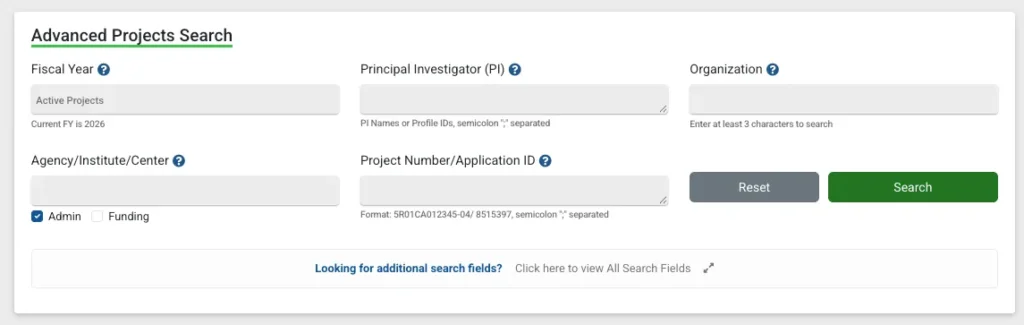
Here is what the experience looks like in practice. Start with the Quick Search box and type almost anything. That could be a PI’s name, an institution, a disease keyword, a project number, or a fiscal year. Or open the Advanced Projects Search to combine precise filters.
Run a search, and the results come back under clear categories: projects, publications, patents, clinical studies, news, and more. Each tab is a different lens on the same funded work. The Projects tab shows the grants themselves. Publications links out to the papers that cite that funding. Patents surfaces inventions reported through iEdison. Clinical Studies connects to trials on ClinicalTrials.gov. And crucially, the results can be exported. You can pull them into Excel and analyze the portfolio on your own terms.
Click into any single project and you get the full record. It shows the principal investigators, the NIH program official, the start and end dates, and the funding amount. It also lists the publications and patents that came out of it. On the left, a filter panel lets you narrow by institute, activity code, state, organization, and fiscal year.
For the technically inclined, NIH offers two power-user routes. ExPORTER lets you bulk-download raw RePORTER data in CSV and XML files going back years. The NIH RePORTER API allows programmatic JSON queries with no authentication required. Both help for building dashboards or running large-scale portfolio analysis.
The Matchmaker Feature: The Part Most People Miss
One tool inside RePORTER deserves special attention. Matchmaker lets you paste in a block of scientific text. That could be an abstract or a specific aims page, up to 15,000 characters. It returns a ranked list of similar funded projects. Better still, it summarizes those matches by program official, institute, review study section, and activity code.
For a scientist choosing where to send a grant application, this is valuable intelligence. You no longer have to guess which NIH institute might fund your work. The text itself points you toward program officers already funding similar science. It is a small feature with an outsized payoff.
What RePORTER Does Not Do — The Honest Limitations
A tool this useful still has real blind spots. Using it well means knowing them.
It measures funding, not impact. RePORTER tells you what was awarded and what was published. Whether the science was any good is a separate question entirely. The database cannot say if the work replicated or changed clinical practice. A large grant with a long publication list is not automatically important.
Publication and patent links depend on self-reporting. The tie between a grant and its papers relies on researchers attributing funding correctly. They do this in systems like My Bibliography and iEdison. Under-reporting and lag are common. So a project’s output can look thinner than it really is.
Data timeliness varies by type. Extramural projects update weekly. But intramural NIH projects refresh only at the close of each fiscal year. Contract data reflects the most recent fiscal year. If you analyze very recent activity, you may see an incomplete picture.
Funding figures are easy to misread. The dollar amounts represent obligations for a given fiscal year. They also bundle direct and indirect (overhead) costs. Multi-component “parent” awards with sub-projects can be double-counted, inflating totals. The debate over indirect costs versus the science itselfis a live and contested one.
It only covers NIH-linked funding. Work backed by private foundations, industry, or other federal agencies will not appear. RePORTER is a window into one very large funder. It is not the whole of American biomedical research.
Where It Fits in the Transparency Landscape
Despite those caveats, RePORTER represents something valuable. It is a public commitment to showing taxpayers where their research dollars go. It sits alongside a growing set of open accountability tools in health and medicine. One example is the Open Payments database that tracks industry payments to physicians. Many RePORTER records point back to published papers. So it also pairs well with knowing how to search PubMed effectively. Together, the two tools let you follow a grant from the first dollar to the final finding.
Privacy concerns are modest here, and by design. Principal investigator names, institutions, and award amounts are already public. This is government spending, not personal data. So RePORTER’s transparency does not come at the cost of individual privacy. The real risks are analytical. It is easy to draw sweeping conclusions from figures that require careful interpretation.
The Bottom Line
NIH RePORTER is one of the most useful open databases in American public science. It turns an opaque, $47-billion funding machine into something searchable and exportable. With the right skepticism, it is also deeply informative. Use it to find collaborators, benchmark institutions, or investigate spending. Use it simply to see where the country’s biomedical priorities lie. Just remember what it really measures: money awarded and output reported, not impact proven. Read it with that distinction in mind, and it becomes indispensable.
Sources
- NIH RePORTER — official search portal
- NIH RePORT — Research Portfolio Online Reporting Tools
- NIH RePORTER Advanced Projects Search
- NIH RePORTER API documentation
- ExPORTER — bulk data downloads
- NIAID: Find Funded Projects Using NIH Databases
- NIGMS: Search Funded Projects Using NIH RePORTER
- NIH Extramural Nexus: Make a Perfect Pair with NIH Matchmaker
- NLM Technical Bulletin: American Recovery and Reinvestment Act of 2009
- Indirect costs and scientific impact at NIMH (PMC)
This article was created with AI assistance and reviewed by a human editor.

