


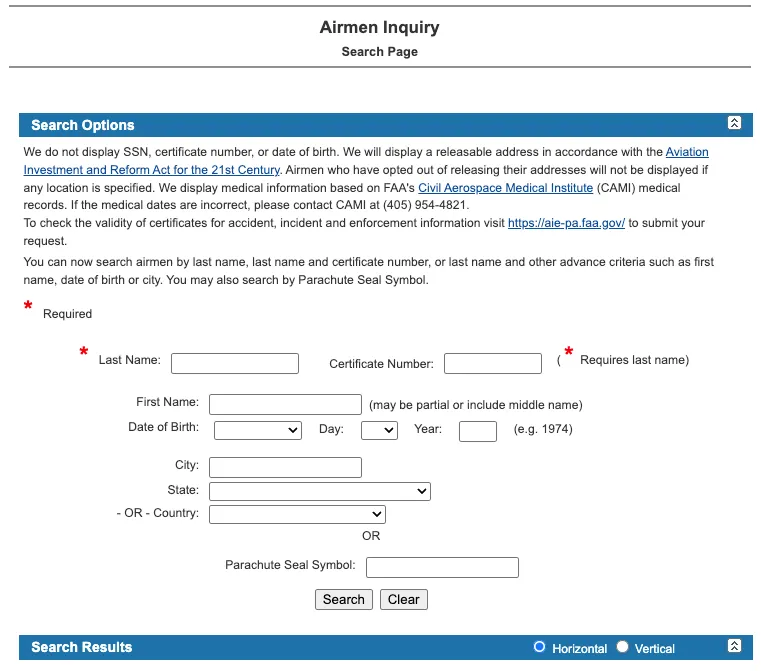
There are more than 900,000 certificated airmen in the United States, and here is the part most people never realize: you can look up almost any one of them by name in about thirty seconds, for free, without logging in. The FAA airman registry – the government’s public database of pilots, mechanics, flight instructors, and drone operators – is one of the most quietly powerful transparency tools in American aviation. It sits in plain sight at the Federal Aviation Administration’s website, yet most travelers, employers, and even some pilots don’t know exactly what it exposes, what it hides, and why any of it matters.
This is not just a novelty search box. The registry underpins hiring decisions, background checks, journalism, insurance underwriting, and safety oversight. It also raises a genuine privacy question that plenty of pilots learn about the hard way. Below is a practical, hands-on look at how the database actually works, who leans on it, and where its blind spots lie.
What Is the FAA Airman Registry?
The FAA airman registry is a searchable public record of individuals the FAA has certificated to operate in the national airspace system. In aviation, “airman” is a legal term of art, not a description of gender or a specific job – it covers pilots at every level, aircraft mechanics, repairmen, flight engineers, dispatchers, parachute riggers, and the fast-growing population of remote (drone) pilots. All of them are maintained by the Civil Aviation Registry in Oklahoma City, and a subset of their certification data is published through the public-facing Airmen Inquiry tool.
The database exists because aviation runs on verifiable credentials. When someone claims to hold a commercial pilot certificate with an instrument rating, that claim needs to be checkable by anyone with a legitimate reason to ask. The registry turns a private credential into a public fact – the same philosophy that drives other professional-verification databases we cover in our industry databases section.
How to Search the FAA Airman Registry
The search itself is refreshingly simple, and I ran through it directly to see what a typical lookup returns. From the Airmen Inquiry page, you enter a last name and a first name, complete a CAPTCHA to prove you’re human, and click the search button. Results appear as a list of matching names almost instantly. Click on an individual result, and the full record for that airman opens up.
If you want to try it with a well-known name, public figures who are openly certificated pilots – like Chesley “Sully” Sullenberger – make clean test cases, precisely because their status is already a matter of public record.
What Each Record Actually Shows
Once you open a record, the information is organized into three clear blocks. In my walkthrough, a record displayed the following:
- Personal Information – mailing address, county, and country (shown when the airman has not opted out of address release).
- Medical Information – medical class, medical date, BasicMed course date, and BasicMed CMEC date, where applicable.
- Certificates – a certificate description block listing the certificate type, date of issue, ratings, type ratings, and any limitations.
That certificate block is the heart of the record. Ratings tell you what an airman is qualified to fly or work on – single-engine land, multi-engine, instrument, rotorcraft – while type ratings identify specific aircraft (a Boeing 737 or a Gulfstream, for instance) that require dedicated training. Limitations flag conditions attached to the certificate. For anyone verifying a credential, this is the payload.
Who Uses the FAA Airman Registry, and Why It Matters
The registry’s users are more varied than you might expect, and each comes with a different problem to solve:
- Employers and charter operators confirm that a job applicant genuinely holds the certificates and ratings listed on a resume before putting them near an aircraft.
- Aviation insurers validate a pilot’s qualifications and currency as part of underwriting a policy.
- Journalists and investigators use it to verify credentials after accidents or in reporting on aviation safety.
- Fellow pilots and flight schools confirm instructor credentials before booking training.
- Buyers and sellers in the general-aviation community cross-check who they’re dealing with.
The core value is trust at scale. Aviation is a domain where a false credential can kill people, so a free, authoritative, always-on lookup solves a real problem: it removes the need to take anyone’s word for it. In that sense the airman registry belongs to the same family as financial-credential tools such as FINRA BrokerCheck and NMLS Consumer Access – public databases built so ordinary people can vet a licensed professional before trusting them.
What the FAA Airman Registry Deliberately Hides
Transparency here is deliberately partial, and understanding the omissions is as important as the data itself. According to the FAA’s Airmen Certification FAQ, the agency does not display an airman’s Social Security number, certificate number, or date of birth anywhere on the website. That’s a meaningful safeguard: the certificate number in particular is sensitive, and its absence limits the registry’s usefulness for identity theft.
Just as notably, the public inquiry does not surface enforcement history. If a pilot has been subject to a suspension or an enforcement action, you will not learn that from the basic Airmen Inquiry. Safety and disciplinary records live in separate systems – including the FAA’s Pilot Records Database (PRD), which airlines use in hiring – so the public registry confirms what someone is certificated to do, not how well they’ve done it.
The Privacy Question: Your Address and the Releasable Airmen File
Here is where the registry becomes genuinely contentious. For airmen who have taken no action, the public record can include a mailing address, county, and country – exactly what I saw in the personal-information block. For most professions that would be unremarkable, but pilots as a group tend to be more privacy-conscious, and many are surprised to find their home address one CAPTCHA away from any stranger.
The bigger exposure is the bulk data. Beyond the one-record-at-a-time web lookup, the FAA distributes a downloadable Releasable Airmen File, and that file is what powers most third-party “pilot lookup” websites. Unless an airman has formally opted out, that bulk file can include the full home address. In other words, the privacy setting you choose on the official registry ripples out to dozens of commercial databases you’ve never heard of.
How to Remove Your Address
Airmen who want their address withheld can change their releasability status. The FAA explains the process on its address releasability page: you file an Airman Release Form with the Airmen Certification Branch in Oklahoma City. A few practical details are easy to miss:
- Submissions go by mail or fax – email is not accepted.
- It can take roughly 60 to 90 days for the change to propagate to the bulk file that feeds outside databases.
- Updating your address through the online portal can reset your opt-out status, so if you move, you may need to re-file to keep your address private.
That last point is the trap. A pilot who carefully opted out years ago can silently become “releasable” again simply by updating their address online – a data-governance quirk worth flagging to anyone who values their privacy.
How It Compares to Other Public Verification Databases
What sets the FAA airman registry apart from many government databases is its combination of breadth and immediacy. It is nationwide rather than state-by-state, it requires no account, and it returns results in real time. Compare that with credential systems that are fragmented across jurisdictions, or transportation datasets like the National Transportation Atlas Database, which is powerful for infrastructure analysis but built for a very different audience.
The trade-off is depth. The registry is a mile wide and an inch deep: it confirms certification status cleanly but tells you almost nothing about experience, flight hours, recency, or conduct. For a legally defensible confirmation, the FAA offers a separate, paid option – a formal Airman Certification Verification issued as a signed letter on FAA letterhead from the Civil Aviation Registry. Employers running formal background checks often use that rather than a screenshot of the free lookup.
Limitations and Data-Quality Caveats
No public database is flawless, and the airman registry has a few honest weaknesses worth naming:
- Common-name ambiguity. Search a name like “James Smith” and you may get a long list of matches with no way to disambiguate without more context, since sensitive identifiers are hidden by design.
- Address lag. Records reflect what the airman last reported to the FAA, and changes to the downloadable file don’t update instantly.
- No conduct data. The absence of enforcement or medical-detail history means the registry should never be mistaken for a full safety background check.
- Third-party drift. Commercial sites that scrape the Releasable Airmen File may show stale or opted-out data long after the official record has changed.
None of these are fatal. They simply define the tool’s lane: quick credential confirmation, not deep investigation.
The Bigger Picture: Transparency Versus Privacy
The FAA airman registry is a small, revealing case study in how a democracy balances openness against personal privacy. Aviation safety benefits enormously from public verifiability – the ability of any employer, insurer, or citizen to confirm that the person at the controls is who they claim to be. Yet that same openness can put a private individual’s home address into the hands of anyone with a keyboard.
The FAA’s answer is a middle path: publish the credentials that matter for safety and trust, shield the identifiers that enable fraud, and give individuals a mechanism – however imperfect – to withhold their address. Whether that balance is calibrated correctly is a fair debate, and reasonable people in the aviation community land on different sides of it.
Using the Registry Well
If you’re checking a credential, start with the official FAA Airmen Inquiry rather than a third-party mirror, and treat it as a first filter – confirmation of certification, not a verdict on competence. If you’re an airman, take five minutes to search your own name and see exactly what the public sees; if your address is showing and you’d rather it didn’t, the opt-out process is straightforward once you know it exists. And if you’re researching the broader landscape of public records, the registry is a strong model for what a well-designed government transparency tool looks like – accessible, authoritative, and honest about its own limits.
For more deep dives into the databases shaping industries, verification, and public accountability, explore our full industry databases collection.
Sources
- FAA Airmen Inquiry – Search Airmen Certificate Information
- FAA – Airmen Certification Frequently Asked Questions
- FAA – Change Your License Information: Add or Delete Your Mailing Address from Public View
- FAA – Pilot Records Database (PRD)
- FAA – U.S. Civil Airmen Statistics
- FAA – Pilot Certificates & Records

