


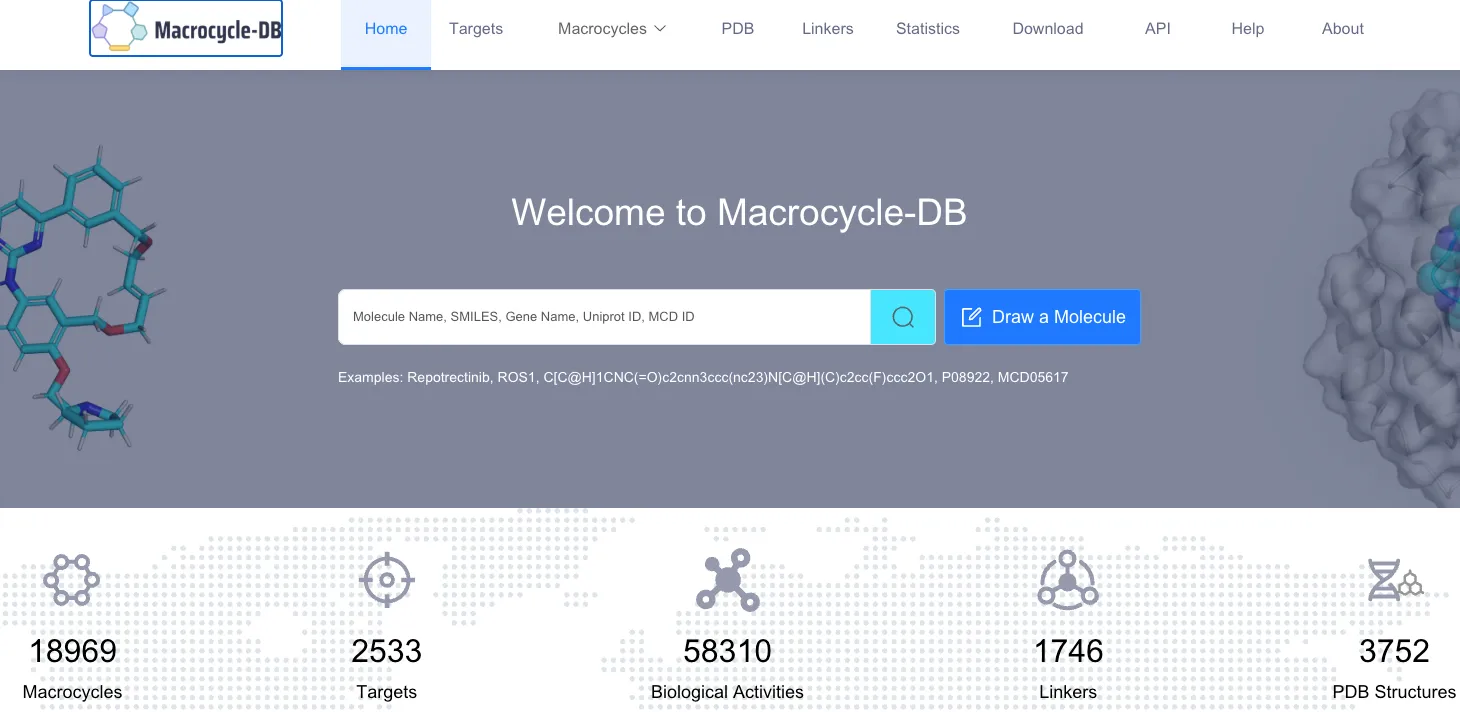
Most drug discovery databases try to include as many different types of compounds as possible. The Macrocycle Database takes a different approach by focusing on a single class of molecules. While this broad coverage is useful for many searches, researchers looking for detailed information about macrocycles have often needed to search across multiple resources. As interest in macrocycles continues to grow, access to organized and searchable data has become increasingly important.
When I tried out Macrocycle-DB it did not feel like a database for chemicals. It felt like a tool that was made to help with a very specific problem in science. Of making users look through millions of compounds that are not related to what they are looking for the platform focuses only on macrocycles. It connects them with the targets they affect in the body, structural data and research that has already been published. The people who made the database wrote about it in a paper that was published in 2026 in Nucleic Acids Research. In the paper they talk about how they tried to bring all the information, about macrocycles that was scattered around and put it into one place, which is Macrocycle-DB.
What Is the Macrocycle Database?
Looking through Macrocycle-DB, it quickly becomes clear that the database was built with a very specific audience in mind. Instead of trying to catalog every type of bioactive molecule, the platform focuses exclusively on macrocycles. According to the project’s publication, the current release includes more than 45,000 compounds, among them approved drugs, clinical-stage candidates, and molecules linked to thousands of protein targets.
That specialization is what makes the database interesting. Researchers can certainly find macrocycles in resources like PubChem or ChEMBL, but locating them often requires additional filtering and verification. Here, the compounds have already been grouped into a dedicated collection, making exploration considerably more straightforward.
During testing, I found it easy to move from a compound record to information about associated targets, structural features, and related molecules. Rather than presenting macrocycles as a small subset of a much larger chemical universe, the database places them at the center of the experience.
Why Macrocycles Matter in Drug Discovery
Macrocycles have attracted growing attention from drug developers over the past decade. One reason is that they can sometimes interact with proteins that have proven difficult to target using conventional small-molecule drugs. Researchers have increasingly explored these compounds in fields ranging from cancer therapeutics to infectious diseases and immune-related disorders.
The pharmaceutical industry has already seen several macrocycle-based medicines reach patients, while many others remain under investigation. As a result, interest in organized macrocycle data has grown alongside interest in the molecules themselves.
The challenge is that macrocycle data has historically been fragmented. One researcher might find structural information in a chemistry database, target information in a protein database, and clinical status in a separate regulatory or trial source. Macrocycle-DB helps reduce that fragmentation by bringing several layers of information into one searchable environment.
How the Macrocycle Database Works in Practice
One of the strongest practical features of the database is its simple search experience.
In my view, the interface is not trying to impress users visually. It is trying to get researchers to the right record quickly, which is exactly what a specialized scientific database should do.
Users can search by:
- molecule name
- SMILES
- gene name
- UniProt ID
- MCD ID
After clicking the search button, the database returns matching records in a structured table.
The search results include:
- MCD ID
- molecule name
- structure
- molecule type
- largest ring size
- gene name
- UniProt ID
- status
This is useful because the results immediately combine chemical, biological, and development-related context. A medicinal chemist can check the compound structure and ring size. A bioinformatics researcher can follow the gene name or UniProt ID. A drug discovery analyst can quickly see whether a compound is approved, clinical-stage, or research-stage.
What You See Inside a Macrocycle Database MCD Record
The most useful part of Macrocycle-DB appears after clicking an MCD ID.
A detailed compound page includes:
- basic information
- representation
- scaffold and linker
- properties
- target
- similar structures
- references
This makes the database more valuable than a simple compound list. The basic information gives the user the identity of the molecule. The representation section supports chemical interpretation. The scaffold and linker information is especially useful for researchers studying how macrocyclic structures are built or modified.
The target section connects the compound to biological activity, while the similar structures section can help identify related molecules worth investigating. The references section is also important because it lets users trace information back to supporting scientific literature.
That traceability is one of the clearest signs that Macrocycle-DB was built for serious research rather than casual browsing.
Who Is Most Likely to Use the Macrocycle Database?
Macrocycle-DB is most useful for readers and professionals working in scientific or technical fields.
Pharmaceutical research teams may use it to identify macrocyclic compounds linked to specific targets. Medicinal chemists may use it to compare scaffolds, linkers, ring sizes, and similar structures. Academic researchers may use it for structure-activity relationship studies or target-focused research.
The database may also be useful for AI-assisted drug discovery. Machine learning workflows often depend on structured, curated datasets. A focused dataset like Macrocycle-DB can be more useful for certain tasks than a broad database where relevant molecules must first be extracted and cleaned.
For readers interested in similar specialized research databases, The Database Search has also covered resources such as IVCDB, which is relevant for compound and biological interaction research.
How Macrocycle-DB Differs From General Chemical Databases
The main difference is specialization.
Large chemical resources are built for breadth. They cover millions of compounds across many areas of chemistry, biology, pharmacology, and toxicology. That breadth is valuable, but it can make focused research slower.
Macrocycle-DB is narrower, but more targeted. It is designed around macrocycles from the beginning.
That means users do not need to start by separating macrocycles from unrelated compounds. The database already does that work and adds macrocycle-specific information such as ring size, scaffold details, linker information, and similar structures.
This does not make broader resources unnecessary. In practice, researchers will likely use Macrocycle-DB alongside PubChem, ChEMBL, DrugBank, UniProt, and other established resources. Its value is not in replacing those databases, but in making one difficult molecule class easier to study.
Data Quality, Transparency, and Reliability
The database’s scientific value depends heavily on curation.
According to the Nucleic Acids Research article, Macrocycle-DB was built from scientific literature, patents, and established public databases, including ChEMBL, DrugBank, ClinicalTrials.gov, the Protein Data Bank, PubChem, the Therapeutic Target Database, and UniProt.
That matters because drug discovery data can be noisy. Compound names may vary. Structures may need standardization. Target relationships may depend on experimental context. Status information can change as clinical programs advance or fail.
Macrocycle-DB addresses part of this problem through structured records, standardized identifiers, and references. Still, users should treat it as a research starting point, not as a final authority for clinical or regulatory decisions.
This is similar to the broader transparency value seen in resources such as the FDA Complete Response Letter Database, where structured access to underlying documentation can help users understand complex scientific and regulatory decisions.
Limitations Users Should Keep in Mind
Macrocycle-DB is valuable, but it has limits.
First, its scope is intentionally narrow. It focuses on macrocycles, so it is not suitable for broad chemical discovery outside that class.
Second, coverage depends on available literature, patents, and source databases. If a compound is new, poorly documented, proprietary, or not yet represented in public scientific sources, it may not appear immediately.
Third, not every record will have the same depth of information. Some compounds will have extensive structural, biological, and reference data. Others may be more limited.
Finally, like many academic scientific databases, long-term usefulness depends on maintenance. Users should check whether the database continues to receive updates over time.
Why This Database Has Practical Value
The practical value of Macrocycle-DB is that it saves time at the early research stage.
A researcher looking for macrocycles associated with a specific protein can search by gene name or UniProt ID. A chemist comparing structural families can review scaffold and linker information. A computational researcher can use the database as a more focused starting point for dataset construction.
For investigative or analytical readers, the database also shows how scientific transparency is evolving. Instead of presenting isolated molecules, Macrocycle-DB connects compounds to targets, structures, properties, similar molecules, and references.
That integrated structure makes it easier to ask better questions:
- Which macrocycles target a specific protein?
- Are similar structures already known?
- Is the molecule approved, clinical-stage, or experimental?
- What scientific references support the record?
- Are there patterns in ring size, scaffold design, or target class?
Specialized databases like the GRAPE Database follow a similar logic: focused datasets can reveal patterns that are harder to detect inside broader repositories.
Final Thoughts
The Macrocycle Database is a strong example of why specialized scientific databases still matter.
Its main strength is not simply its size, although more than 45,000 macrocycles is substantial. Its real value is the way it organizes macrocyclic compounds around structure, targets, properties, similar molecules, and references.
For medicinal chemists, bioinformatics researchers, pharmaceutical analysts, and AI drug discovery teams, Macrocycle-DB offers a focused way to explore a molecule class that is increasingly important but often difficult to study efficiently.
It should not be treated as a replacement for primary literature or broader chemical databases. But as a starting point for macrocycle-focused research, it is practical, well-structured, and genuinely useful.
Sources
This article was created with AI assistance and reviewed by a human editor.

