


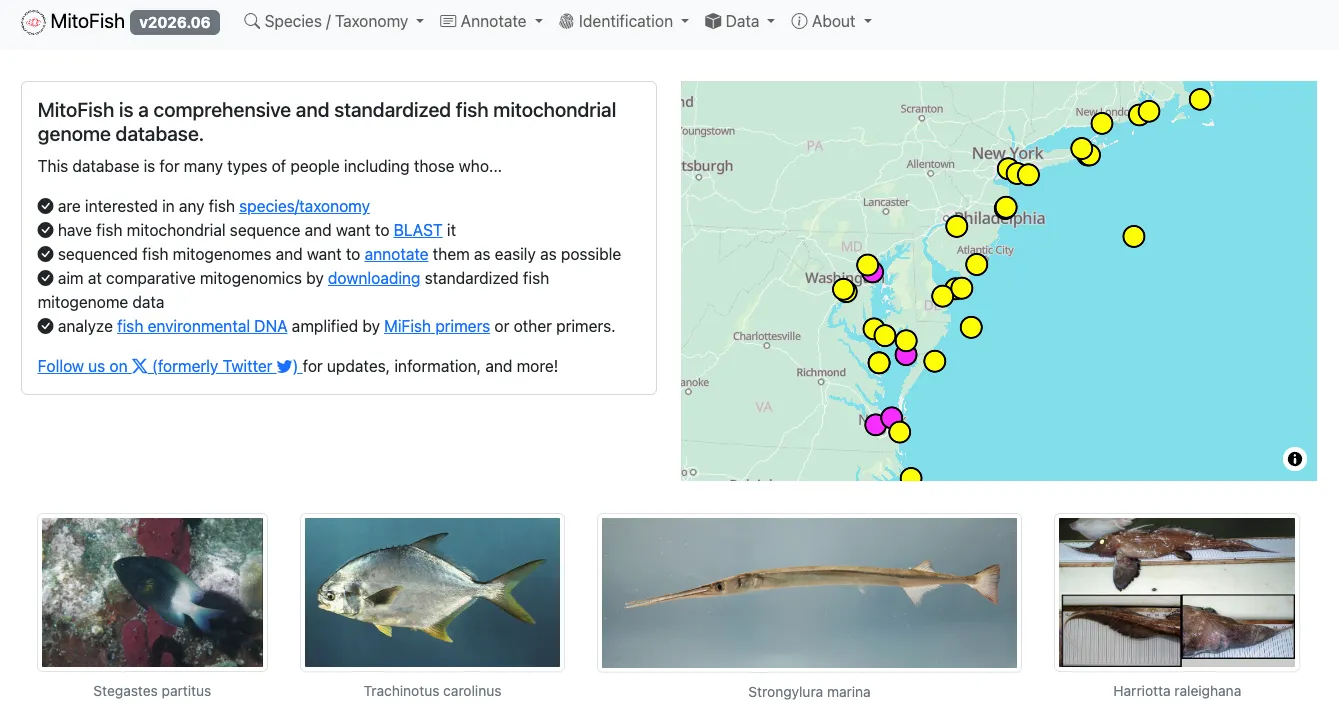
Scoop a cup of water from a river, and in principle you can list the fish that swam through it days earlier — without ever seeing a single one. That is not science fiction. It is the everyday reality of environmental DNA research, and it leans on an unglamorous but essential piece of infrastructure: the MitoFish database. Most people who eat fish, fund conservation, or worry about invasive species have never heard of it, yet the reliability of a growing share of aquatic biodiversity monitoring quietly depends on what is — and isn’t — inside it.
MitoFish sits in a strange spot. It is one of the most cited fish genomics resources in the world, freely available to anyone, and maintained by a single academic lab. It is also, by the honest admission of its own creators, incomplete and only as trustworthy as the public sequence data feeding it. That tension is exactly what makes it worth a close look.
What the MitoFish Database Actually Is
MitoFish, formally the Mitochondrial Genome Database of Fish, is a curated reference collection of fish mitochondrial genomes — the small, circular loops of DNA found in the mitochondria of every fish cell. It has been developed and maintained since 2013 by the Iwasaki laboratory at the Atmosphere and Ocean Research Institute, University of Tokyo, and first described in the journal Molecular Biology and Evolution.
It is easiest to think of MitoFish not as one tool but as three that grew together:
- The database itself — thousands of complete fish mitogenomes plus a much larger pool of partial reference sequences, cross-linked to NCBI GenBank accessions.
- MitoAnnotator — automated software that takes a raw fish mitogenome and labels its genes accurately, a job that used to be slow and error-prone when done by hand.
- The MiFish pipeline — a web platform, added in 2018, that matches environmental DNA sequencing reads against the reference set to identify which species are present in a water sample.
That combination is unusual. Most genomic resources give you either raw sequences or an analysis tool, rarely both wired together for one taxonomic group. According to the developers’ 2023 review, “MitoFish, MitoAnnotator, and MiFish Pipeline: Updates in 10 Years”, the suite had passed a decade of continuous development, was drawing more than 48,000 visits a year, and had been cited over 700 times as of early 2023. For a niche academic database, those are serious numbers.
Why Fish Mitochondrial Genomes Matter
Mitochondrial DNA is the workhorse of species identification for a few practical reasons. There are many copies per cell, so it survives in degraded samples where nuclear DNA has fallen apart. It mutates fast enough to separate closely related species but stays consistent within one. And crucially, it is what fish shed constantly into water through skin cells, mucus, and waste.
The MiFish approach targets a short stretch of the 12S ribosomal RNA gene — roughly 170 base pairs — using primers designed by Miya and colleagues in 2015. That fragment is long enough to distinguish most fish species, short enough to survive in the wild, and universal enough to amplify across the vast majority of teleosts and sharks. When a lab sequences the DNA floating in a lake, they get thousands of these fragments. MitoFish is the dictionary they look them up in.
Without a reliable reference library, that sequencing data is just noise. This is the real problem MitoFish solves: it converts anonymous strings of A, C, G, and T into named, traceable species.
Inside the MitoFish Database: A Hands-On Look
Spend a few minutes on the site and its priorities become clear. After opening the database, the data is available almost immediately — no account, no paywall, no lengthy load. Search results are plotted on a rotating globe, so you see at a glance where a species’ sequences were collected around the world. For anyone used to clunky bioinformatics portals, that immediacy is refreshing.
What You See When You Open a Record
Click through to a single species or sequence and the record opens up into several distinct layers of information:
- Database cross-references linking the entry back to external repositories such as NCBI.
- A species image, giving a visual anchor to the genetic data.
- Metadata describing the record’s basic attributes.
- Global occurrence displayed geographically, showing where the organism has been reported.
- Related mitochondrial sequences, laid out in a detailed table covering the accession number, creation date, specimen, country of origin, sequence length in nucleotides, topology, category, gene, and data source.
- Multiple sequence alignment, letting you compare related sequences side by side to judge how similar or divergent they really are.
That last feature matters more than it looks. Being able to eyeball an alignment is what separates a database you trust from one you take on faith — you can actually see whether two “different” species are genuinely distinct at the barcode level or effectively identical. You can also pull the underlying reference data yourself through the MitoFish download page or browse taxa through its species search, which is the kind of open access that lets independent researchers verify claims rather than trust them.
Who Uses the MitoFish Database — and for What
The user base is broader than “fish scientists.” In practice, the MitoFish database quietly underpins work across several fields:
- Conservation biologists monitoring endangered or rare species that are hard to survey by netting or diving.
- Fisheries managers and regulators checking stock composition or verifying species in the seafood supply chain.
- Environmental consultants running eDNA surveys before dredging, dam removal, or coastal construction.
- Invasive-species programs scanning for early signs of unwanted arrivals like Asian carp before populations explode.
- Academic ecologists studying biodiversity patterns across rivers, lakes, and oceans.
A concrete example: rather than electrofishing a stream repeatedly to prove an imperiled fish is present, a team can filter water, sequence the eDNA, and match it against MitoFish — cheaper, faster, and far less disruptive to the animals. This same logic connects fish work to the broader world of open biodiversity data, the kind covered across the science databases we profile, from the African Plant Database to the GlobalFungi database. Each solves the same underlying puzzle: turning scattered molecular evidence into a coherent map of life.
How the MitoFish Database Compares to Other Genomic Databases
It is fair to ask why anyone needs a fish-specific database when giants like NCBI GenBank already store everything. The answer is curation and fit.
GenBank is comprehensive but generic; it holds every organism and every gene, with uneven quality control and no built-in workflow for fish eDNA. BOLD, the Barcode of Life Data System, is excellent but standardizes on the COI gene — a marker that works well for many animals but performs poorly for fish eDNA compared with the 12S region MiFish uses. MitoFish’s value is that it is opinionated: it focuses on one group, one set of markers optimized for that group, and pairs the reference data with annotation and analysis tools built for the same job.
In other words, MitoFish trades breadth for depth. That is a strength for fish researchers and, as we’ll see, also the root of its main weaknesses.
The Limits: Data Gaps, Contamination, and Resolution
No serious review of the MitoFish database should present it as flawless, and its own developers don’t. Several real constraints deserve attention.
Reference Gaps and Geographic Bias
A reference database can only identify what it already contains. Many fish species — especially in the tropics, the deep sea, and under-studied freshwater systems — simply have no reference sequence yet. The coverage also skews toward regions with active sequencing programs, which historically means temperate and East Asian waters are far better represented than, say, remote parts of Africa or South America. The practical result: an eDNA survey in a data-rich region will identify most of what it finds, while the same survey in a data-poor region may return a frustrating list of “unassigned” reads.
Contamination and Misidentification
Because MitoFish draws heavily on public sequence repositories, it inherits their errors. The team behind the 2026 successor platform, MitoNGS, was blunt about this, noting that accurate identification “remains challenging due to incomplete and contaminated reference databases, as well as ambiguous taxa sharing identical barcode sequences.” If a sequence was mislabeled when first uploaded to GenBank, that mistake can propagate downstream. This is the classic “garbage in, garbage out” risk of any reference database that aggregates community-submitted data.
Limited Resolution of a Short Marker
The very fragment that makes MiFish robust — a short 12S region — also limits it. Some closely related species, or members of a “species complex,” share nearly identical sequences over that stretch and cannot be told apart from eDNA alone. In those cases the database can honestly get you to a genus or a group, but not a confident single species.
Transparency, Access, and Data Ethics
On transparency, MitoFish scores well. It is free, requires no login, publishes its methods in peer-reviewed journals, cross-references every entry to source accessions, and lets users download the underlying data. That traceability is precisely what responsible open data looks like, and it stands in useful contrast to the opaque, subscription-walled datasets common in other sectors — a recurring theme across the ESG databases and governance resources where access and auditability are constant concerns.
Privacy, in the usual sense, is barely an issue here: MitoFish stores genetic and geographic data about fish, not people. But biodiversity data is not entirely neutral. Precise occurrence records for rare or commercially valuable species can, in theory, guide poachers or unregulated collectors to sensitive populations. It is a smaller concern than in, say, mammal or orchid databases, yet it is the kind of ethical wrinkle that thoughtful data stewards keep in mind when deciding how granular public location data should be.
Where the MitoFish Database Is Heading
The project is not standing still. In 2026 its developers introduced MitoNGS, a next-generation platform meant to succeed the MiFish pipeline, published again in Molecular Biology and Evolution. It widens the reference net to include non-fish species, adds annotations for tricky “heterospecific” regions, brings in a “species complex” strategy that uses habitat and geographic data to resolve ambiguous matches, and supports newer sequencing technologies including portable Nanopore devices. In short, the roadmap directly targets the weaknesses described above.
Final Assessment
The MitoFish database is a quietly consequential piece of scientific infrastructure — well-built, genuinely open, and central to the fast-growing field of environmental DNA monitoring. Its strengths are focus, transparency, and an integrated workflow that few competitors match for fish. Its limits are equally real: uneven geographic coverage, inherited errors from public repositories, and the resolution ceiling of a short genetic marker.
For anyone relying on it — a fisheries agency, a conservation nonprofit, an environmental consultant — the honest takeaway is not “trust it completely” but “understand what it can and cannot see.” Used with that awareness, MitoFish is one of the better examples of how open, specialized databases can turn a cup of murky water into a credible census of life beneath the surface.
Sources
- MitoFish – Mitochondrial Genome Database of Fish: https://mitofish.aori.u-tokyo.ac.jp/
- MitoFish species search: https://mitofish.aori.u-tokyo.ac.jp/species/search
- MitoFish data download: https://mitofish.aori.u-tokyo.ac.jp/download
- Zhu, T. et al. (2023). MitoFish, MitoAnnotator, and MiFish Pipeline: Updates in 10 Years. Molecular Biology and Evolution, 40(3): msad035. https://academic.oup.com/mbe/article/40/3/msad035/7037602
- Sato, Y. et al. (2018). MitoFish and MiFish Pipeline: A Mitochondrial Genome Database of Fish with an Analysis Pipeline for Environmental DNA Metabarcoding. Molecular Biology and Evolution, 35(6): 1553. https://academic.oup.com/mbe/article/35/6/1553/4970566
- Iwasaki, W. et al. (2013). MitoFish and MitoAnnotator: A Mitochondrial Genome Database of Fish with an Accurate and Automatic Annotation Pipeline. Molecular Biology and Evolution, 30(11): 2531. https://academic.oup.com/mbe/article/30/11/2531/1260315
- Zhu, T. et al. (2026). MitoNGS: an online platform to analyze fish metabarcoding data in high resolution. Molecular Biology and Evolution, 43(3): msag046. https://academic.oup.com/mbe/article/43/3/msag046/8489958
This article was created with AI assistance and reviewed by a human editor.

