


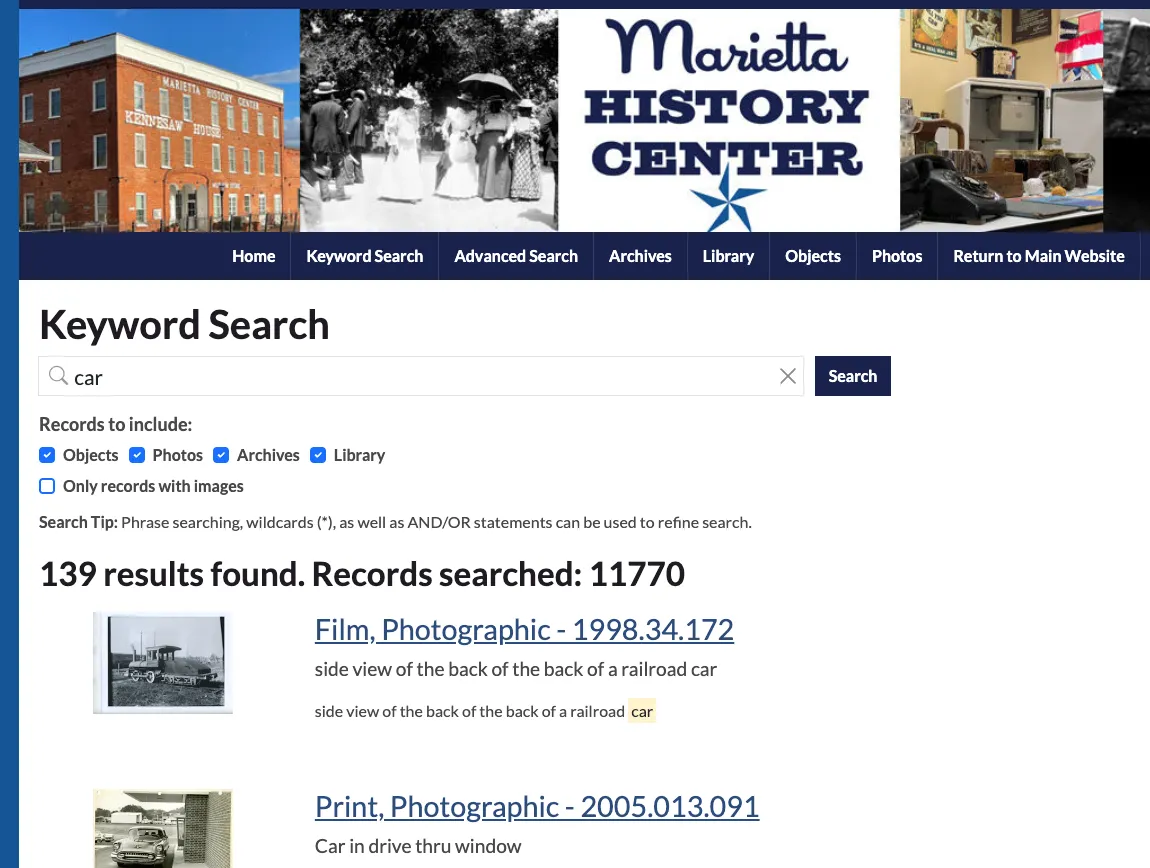
The new Marietta History Center database puts 10,000+ artifacts online for free. Here is how it works, what you can find, and where it still falls short.
The Marietta History Center database opened to the public for the first time in late 2025. Now anyone with an internet connection can browse thousands of photographs, objects, and archival records from a single Georgia town. That sounds modest. It is not. Most small-museum collections never reach the web at all. This one did, and the way it works tells you a lot about how local American history goes digital today.
What the Marietta History Center database actually is
The Marietta History Center sits inside the historic Kennesaw House in Marietta, Georgia. The museum has welcomed visitors since 1996. The 1845 building once served as a cotton warehouse, later became a hotel, and even held wounded soldiers during the Civil War. That deep local history is exactly what the new catalog now puts within reach.
The online collection runs on PastPerfect Online, a platform that many U.S. museums use to publish their collections. You reach the Marietta catalog at mariettahistory.catalogaccess.com. No account, no paywall, no application form.
At launch the catalog held more than 10,000 records, and most of them are photographs. The museum aims to digitize 15,000 items by March 2026. Christa McCay, the collections manager, leads the project and has been refreshingly honest about the grind behind it. Cataloging a single artifact takes roughly an hour of staff time. She describes the work as “always going to be an ongoing project.”
How to search the Marietta History Center database
The catalog gives you two ways in: a simple keyword search and a more precise advanced search. I tested both, and the difference matters once your search returns too many results.
Keyword Search
The keyword search scans many fields at once. By default it links your words with OR, so a search for Kennesaw House pulls records tied to Kennesaw or House. Type AND between two words to require both. Wrap a phrase in quotation marks for an exact match. Add an asterisk as a wildcard, so histor* finds history, historical, and histories. The search ignores capitalization entirely.
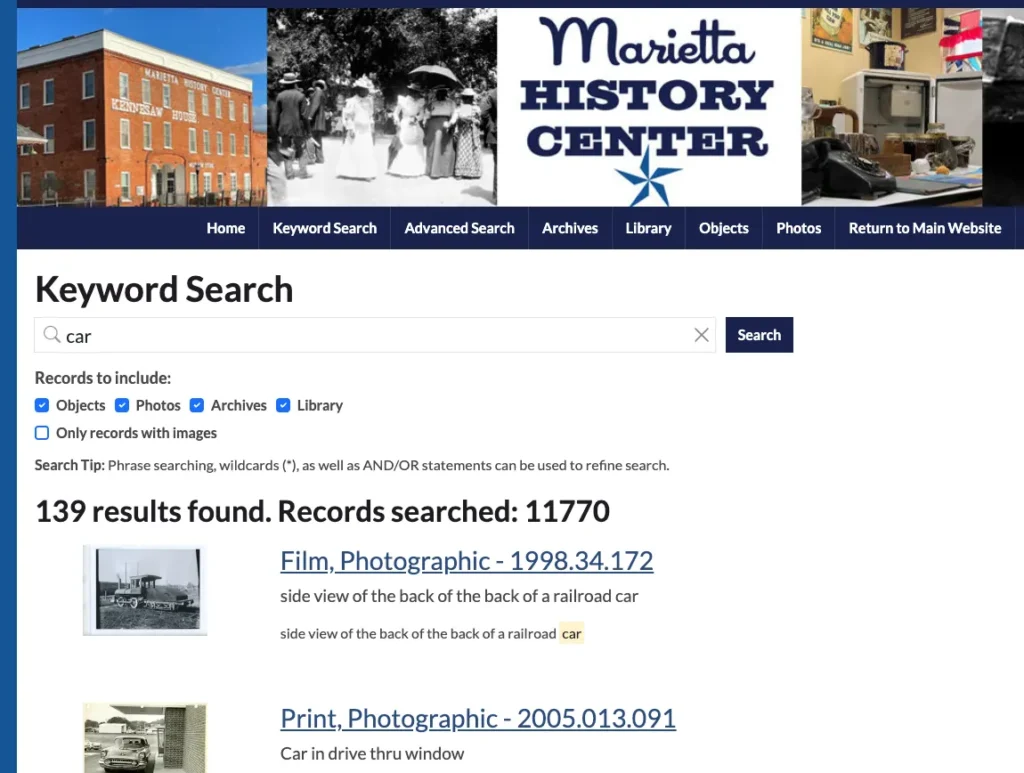
To see how it behaves, I ran a plain term: car. The catalog returned matching records instantly. Each result lays out the same useful set of details: a thumbnail image, the object name, a catalog number, a description, the title, the collection it belongs to, and the search terms attached to the record. That structure makes scanning fast and copying a citation simple.
Advanced Search
The advanced search earns its name. You can target a word or phrase inside a single field, or combine several fields to narrow things down. Searching White in the People field, for example, surfaces records linked to the White family without burying you under every black-and-white photo in the archive. Phrase quotes and wildcards work here too, and you can dig into People and Creator records directly.
What records you can find inside
The catalog splits its holdings into four clear categories. Each one opens a different window into Marietta and Cobb County history:
- Photos — the largest group by far, and the backbone of the collection at launch.
- Objects — physical artifacts, from household items to military pieces.
- Archives — documents, papers, and manuscript materials.
- Library — books and printed reference holdings.
This mirrors how museum-focused resources increasingly organize public collections online. If you enjoy exploring this kind of catalog, our guide to the Hawaii Public Art Collection Database covers a similar state-funded archive built for open browsing.
Who uses it and what problem it solves
The audience here is wider than you might guess. Genealogists hunting for ancestors lead the pack. A single tagged photograph can confirm a family name, a home, or a face that no document records. Students and teachers use the catalog for local history projects. Researchers and authors mine it for primary sources. Curious residents simply search their own street.
The core problem the catalog solves is access. For decades, viewing these items meant booking an appointment and visiting in person. Now the collection travels anywhere. That shift matters most for people who left Marietta but still carry roots there.
How the Marietta History Center database stands apart
Large genealogy platforms hold billions of records but spread thin across the whole country. The Marietta catalog goes the other way. It trades breadth for depth. You will not find national census rolls here. You will find one community documented closely, photo by photo, with local context that national databases flatten.
The crowdsourcing model also sets it apart. McCay actively invites the public to help. Spot a wrong date, recognize a face, or know a location? Email the museum, and staff add your knowledge to the record. Few large databases let ordinary users improve the data this directly.
Limits of the Marietta History Center database
A good guide names the weak spots, so here are the honest ones. The collection leans heavily toward photographs, which means objects, archives, and library holdings still feel thin by comparison. The catalog is also young and incomplete. With staff adding records an hour at a time, gaps are unavoidable for now.
Data quality varies too. Some records carry full descriptions and dates; others wait for the crowdsourced details the museum openly requests. Treat unconfirmed names and locations as leads, not facts. The scope stays tightly local, so this is a Marietta and Cobb County resource, not a national one.
One structural risk deserves a mention. The catalog lives on a third-party domain rather than the museum’s own website. Hosted links like these can change over time, so bookmark the official Marietta History Center site as your stable starting point.
The transparency angle
For a public institution, openness counts as a feature. This catalog scores well on that front. It charges nothing, demands no login, and welcomes correction from anyone who spots an error. The public crowdsourcing model turns visitors into fact-checkers, which strengthens accuracy over time rather than freezing mistakes in place.
Privacy questions stay mild here, since these are historical records meant for public view. Still, crowdsourced identification of people in old photographs is worth handling with care. The museum’s invitation to correct and contribute keeps that process visible and accountable.
The bottom line
The Marietta History Center database is a small, focused, genuinely useful archive that punches above its size. It will not replace a national genealogy service. It was never meant to. What it offers instead is rare: a single American community, documented in depth, opened freely to the world, and improving with every contribution. For anyone with a connection to Marietta, that is reason enough to start searching. For everyone else, it is a clear model of how local history should go online. Browse more open archives like it in our collection of free and public education databases.
Sources
- Marietta History Center Online Collections (PastPerfect Online catalog)
- 95.5 WSB — “Marietta History Center unveils online database with thousands of artifacts”
- Marietta History Center — “Discover Marietta’s Past Online”
- Marietta History Center — About Us (Kennesaw House history)
- PastPerfect Museum Software (platform behind the catalog)

